In my last post, I described the medical crises that led E. and me to decide that Cosmo should be put to sleep. But there were also several strange coincidences and happenings that reinforced our conviction that Cosmo's time had come. If I were a religious person, I might interpret these events as divine intervention. Instead, I prefer to call them signs and portents.
The first of these occurred the day before Cosmo's death, as E. and I returned home from a walk. I was telling E. that I had decided to stop agonizing about how we would decide if and when the time had come to euthanize Cosmo. I said I believed we would just know. Suddenly, E. exclaimed "What's this?"
It was our stone bunny statue, which stands in the flower bed adjacent to our front walk. The bunny had fallen face-down in the soil. That bunny has stood on the same spot since we moved into our house ten years ago. In fact, it's at least as old as Cosmo, having adorned the garden in our prior house as well. The statute has survived nor'easters and blizzards without ever toppling over.
E. quickly righted the bunny and re-set it on its appointed spot. We shrugged off the occurrence, but it rattled us nonetheless. A sign that we should think about ending Cosmo's life? Hardly, yet in retrospect it seemed a portent of Cosmo's own shocking collapse the following morning from a massive seizure.
That evening, E. and I watched the last episode of the first season of Deadwood, an HBO series set in the late-nineteenth-century American west. One of the characters is a minister who begins having seizures in an earlier episode. Eventually, the local doctor realizes that the poor man has a brain tumor. By the last episode, his condition has become dire. His seizures are terrible, with his limbs and head contorting uncontrollably. The doctor prays that God will take him. Finally, in a strangely moving scene, one of the main characters enters the room where the minister lies and, while embracing him, smothers him with a handkerchief, euthanizing him.
The next morning, when Cosmo began having his own terrible seizure, as I tried to hold him and comfort him, E. and I looked at one another. "The minister," E. said. The way Cosmo's limbs and head contorted reminded us of the seizure we'd watched on the television drama the night before. The minister's seizures had finally been stopped by a mercy killing. Was this a sign?
Now rewind to just a few short moments before Cosmo's seizure began. Until then, it had seemed like an unremarkable morning. E. had taken Cosmo out for a brief walk and Cosmo was sitting on his mat in the kitchen, as usual. I was preparing a bowl of cereal for myself. Cosmo normally liked to wait until I began eating my breakfast before eating his food. Prior to sitting down at the table, I glanced at the latest New Yorker to see if there were any articles I wanted to read. My eye was immediately caught by an article by Atul Gawande. Its title — "Letting Go - Rethinking end-of-life treatment."
Although I knew the title referred to human end-of-life dilemmas, I immediately thought of Cosmo and set the magazine on the table so I could read the article. I turned toward Cosmo and noticed that he was trembling. I knelt down beside him and petted him. He seemed to calm down. I stood up to get a spoon for my cereal and when I glanced at Cosmo again his limbs were contorted and I realized he was having a very strong seizure. So, rather than reading an article about end of life, the next hour found me considering whether to actually end my dog's life. Another sign? I'd like to think so, because somehow that allows me to pretend that Cosmo's fate was predetermined and not merely the result of a coldly rational decision.
Eight days have passed since Cosmo's death. I'm still struggling with the trauma of putting him to sleep, but a little less so during the past couple of days. I've realized that I've been using my guilt about being the agent of Cosmo's death as a way to avoid facing my grief. There's never a right time to lose an animal you love, even if all the signs tell you it's time.
Friday, August 6, 2010
Tuesday, August 3, 2010
Making the Decision to End Our Pet's Life
I still can't believe Cosmo is gone. As hard as it feels to lose him, there's something especially haunting about having been the one (along with E.) who decided to end his life.
I never thought it would come to this. While I knew that many pet owners put their ailing pets to sleep rather than allow them to suffer, I preferred to imagine that Cosmo would remain healthy until he was very old, then would simply go to sleep on his comforter beside our bed and never wake up. Unfortunately, that's not the way it happened.
By the time Cosmo reached his thirteenth birthday this past June, he had significant health issues. Controlling his seizures required ever-higher doses of medicine, which put his liver and pancreas at risk. Recently, he began showing a variety of disturbing symptoms — excessive thirst, excessive hunger, hair loss, panting, fatigue, muscle weakness, and a distended belly. In addition, he injured one of his front legs, so he had to be carried up and down the stairs.
Due to the muscle weakness and leg injury, Cosmo couldn't accompany us on long walks. We still took him for strolls around the neighborhood, but often he had to be carried most of the way. In retrospect, I can see that Cosmo's quality of life was eroding before my eyes, but the decline was gradual enough that I remained in denial for a long time.
Then Cosmo began showing signs of incontinence. His excessive thirst, which led to excessive drinking and an over-full bladder, was taking its toll. This new symptom couldn't be ignored. Cosmo had been totally house-trained by the time he was eight days old and had never had an accident in thirteen years. A little Googling regarding the incontinence revealed that, combined with all his other symptoms, Cosmo probably had Cushing's Syndrome, which is caused by excess production of cortisol, a steroid. I took him to the vet, where tests confirmed that he indeed had Cushing's.
Cushing's is an awful disease when left untreated, but the vet told me that a new medication, trilostane, could treat Cushing's with great success by suppressing production of cortisol. She was optimistic that if we could get both the Cushing's and Cosmo's seizures under control, he would feel well and function well again. So, we started him on the trilostane.
We'll never know exactly what happened on that fateful morning to cause a seizure a hundred times worse than the mild partial seizures Cosmo had always experienced before. The massive seizure took place on the fourth day after we began the trilostane, just as it was reaching effective levels. Apparently, the suppression of cortisol due to the trilostane had a catastrophic affect on Cosmo's body's ability to regulate his seizures.
Once Cosmo began seizing, at around 7:45 a.m., he didn't stop. Despite the seizure's severity, Cosmo appeared to be conscious, making the situation all the more heartrending.
I felt immediately that the trilostane had something to do with the seizure, since absolutely nothing else had changed in his treatment. I realized we faced a terrible choice — if we were able to get the seizure under control (a big if), we could stop giving Cosmo the trilostane, but then the Cushing's Syndrome would continue to worsen. On the other hand, if we kept Cosmo on the trilostane, we risked another horrible seizure, something I couldn't bear to think about, for Cosmo or for myself, either.
At 8:30, when my vet's office opened, I called her. Cosmo's seizure hadn't stopped. While she offered a couple of treatment options, like trying a different seizure medication, she felt that it made sense to consider putting Cosmo to sleep. But, of course, she left the decision to E. and me. We agonized for a while, then called and arranged to bring Cosmo to her office at 10:30 a.m.
Though I had always hoped Cosmo would live a long, healthy life and pass away painlessly in his sleep, during his last weeks I had faced the fact that if I wanted to prevent him from suffering, I might have to intervene and have him euthanized. I wondered how I would know if and when the time came. Despite Cosmo's worsening health, he still sometimes acted like his normal, adorable self. How could I choose to put him to sleep while he still had a reasonable quality of life?
But that was exactly the point. I didn't want Cosmo to suffer. I wanted him to die before his life lost all joy. As it was, I wasn't really sure whether or not Cosmo was in pain. A few years earlier, he'd had a terrible tooth abscess that was discovered during a routine dental cleaning. As far as I could tell, Cosmo hadn't been in any pain from the abscess, yet the dental vet told me it probably hurt him a great deal.
"Dogs are stoics," he said.
During the week before his death, I did have one indication that Cosmo was in pain. When holding him, I was always careful not to put pressure on his distended belly. Nevertheless, during that last week of his life, when I picked Cosmo up, he would sometimes breathe in with a catch in his throat and then emit a long sigh. He sounded sad, as if he were hurting.
In the end, the magnitude of Cosmo's final seizure made it clear that the time had come. I'm grateful that I was home when it occurred, so I could hold him and offer some small comfort to alleviate the terror he must have been feeling. I'm also grateful for the loving care he received from my vet. She sedated him so that he fell gently asleep in our arms, then took him from us to administer the fatal dose of barbiturate that would end his life.
Despite believing that we made the right decision at the right time, I nevertheless have experienced guilt in addition to grief. It's hard playing God. But I'm comforted by my conviction that Cosmo wouldn't blame me. He loved me unconditionally. An old New Yorker cartoon expresses my feelings perfectly — "Please God, help me be as good a person as my dog thinks I am."
I never thought it would come to this. While I knew that many pet owners put their ailing pets to sleep rather than allow them to suffer, I preferred to imagine that Cosmo would remain healthy until he was very old, then would simply go to sleep on his comforter beside our bed and never wake up. Unfortunately, that's not the way it happened.
By the time Cosmo reached his thirteenth birthday this past June, he had significant health issues. Controlling his seizures required ever-higher doses of medicine, which put his liver and pancreas at risk. Recently, he began showing a variety of disturbing symptoms — excessive thirst, excessive hunger, hair loss, panting, fatigue, muscle weakness, and a distended belly. In addition, he injured one of his front legs, so he had to be carried up and down the stairs.
Due to the muscle weakness and leg injury, Cosmo couldn't accompany us on long walks. We still took him for strolls around the neighborhood, but often he had to be carried most of the way. In retrospect, I can see that Cosmo's quality of life was eroding before my eyes, but the decline was gradual enough that I remained in denial for a long time.
Then Cosmo began showing signs of incontinence. His excessive thirst, which led to excessive drinking and an over-full bladder, was taking its toll. This new symptom couldn't be ignored. Cosmo had been totally house-trained by the time he was eight days old and had never had an accident in thirteen years. A little Googling regarding the incontinence revealed that, combined with all his other symptoms, Cosmo probably had Cushing's Syndrome, which is caused by excess production of cortisol, a steroid. I took him to the vet, where tests confirmed that he indeed had Cushing's.
Cushing's is an awful disease when left untreated, but the vet told me that a new medication, trilostane, could treat Cushing's with great success by suppressing production of cortisol. She was optimistic that if we could get both the Cushing's and Cosmo's seizures under control, he would feel well and function well again. So, we started him on the trilostane.
We'll never know exactly what happened on that fateful morning to cause a seizure a hundred times worse than the mild partial seizures Cosmo had always experienced before. The massive seizure took place on the fourth day after we began the trilostane, just as it was reaching effective levels. Apparently, the suppression of cortisol due to the trilostane had a catastrophic affect on Cosmo's body's ability to regulate his seizures.
Once Cosmo began seizing, at around 7:45 a.m., he didn't stop. Despite the seizure's severity, Cosmo appeared to be conscious, making the situation all the more heartrending.
I felt immediately that the trilostane had something to do with the seizure, since absolutely nothing else had changed in his treatment. I realized we faced a terrible choice — if we were able to get the seizure under control (a big if), we could stop giving Cosmo the trilostane, but then the Cushing's Syndrome would continue to worsen. On the other hand, if we kept Cosmo on the trilostane, we risked another horrible seizure, something I couldn't bear to think about, for Cosmo or for myself, either.
At 8:30, when my vet's office opened, I called her. Cosmo's seizure hadn't stopped. While she offered a couple of treatment options, like trying a different seizure medication, she felt that it made sense to consider putting Cosmo to sleep. But, of course, she left the decision to E. and me. We agonized for a while, then called and arranged to bring Cosmo to her office at 10:30 a.m.
Though I had always hoped Cosmo would live a long, healthy life and pass away painlessly in his sleep, during his last weeks I had faced the fact that if I wanted to prevent him from suffering, I might have to intervene and have him euthanized. I wondered how I would know if and when the time came. Despite Cosmo's worsening health, he still sometimes acted like his normal, adorable self. How could I choose to put him to sleep while he still had a reasonable quality of life?
But that was exactly the point. I didn't want Cosmo to suffer. I wanted him to die before his life lost all joy. As it was, I wasn't really sure whether or not Cosmo was in pain. A few years earlier, he'd had a terrible tooth abscess that was discovered during a routine dental cleaning. As far as I could tell, Cosmo hadn't been in any pain from the abscess, yet the dental vet told me it probably hurt him a great deal.
"Dogs are stoics," he said.
During the week before his death, I did have one indication that Cosmo was in pain. When holding him, I was always careful not to put pressure on his distended belly. Nevertheless, during that last week of his life, when I picked Cosmo up, he would sometimes breathe in with a catch in his throat and then emit a long sigh. He sounded sad, as if he were hurting.
In the end, the magnitude of Cosmo's final seizure made it clear that the time had come. I'm grateful that I was home when it occurred, so I could hold him and offer some small comfort to alleviate the terror he must have been feeling. I'm also grateful for the loving care he received from my vet. She sedated him so that he fell gently asleep in our arms, then took him from us to administer the fatal dose of barbiturate that would end his life.
Despite believing that we made the right decision at the right time, I nevertheless have experienced guilt in addition to grief. It's hard playing God. But I'm comforted by my conviction that Cosmo wouldn't blame me. He loved me unconditionally. An old New Yorker cartoon expresses my feelings perfectly — "Please God, help me be as good a person as my dog thinks I am."
| Cosmo in better days |
Friday, July 30, 2010
Cosmo, June 15, 1997 - July 29, 2010
| Cosmo on July 17, 2010 |
In a subsequent post, I'll talk about the agonizing decision to end Cosmo's life, but today I want to share some thoughts about the love that my pet brought into my life.
Cosmo was my constant companion. At home, he followed me everywhere and would gladly have accompanied me to restaurants and other venues, if only he'd been allowed. He stayed next to my desk while I worked. Aside from an occasional bark if he heard an airplane or spied a bird through the window, he was content to lie by my side. If I worked too long without taking a break to play with him, he'd let me know by carrying a squeaky toy over and reminding me.
The house feels empty without him. Although he weighed a scant 7½ pounds, his presence was all around. Returning home to quietude instead of his invariably-happy greeting will be hard to bear. Reading or watching TV without being able to hold him on my lap won't feel the same. And I'll miss our riotous play periods, with Cosmo chasing a toy I'd thrown and ferociously pouncing on it, then joyously carrying it back to me so he could triumphantly go "through the tunnel," that is, through my bent legs.
Cosmo loved E. and our two sons. Each had his own special relationship with him. And Cosmo made all of us better people. We loved him and, by extension, grew to love other animals. We felt a kinship to other pet owners, having learned firsthand about the profound bond that can arise between people and their pets.
Cosmo trusted us. Tiny though he was, he never seemed to fear that we'd step on him or inadvertently kick him. Miraculously, we never did. Well, almost never.
We tried to give Cosmo a life filled with only good things—kindness, attention, plenty of food and water, a warm comfortable environment, long walks with his pack (our family), and countless opportunities for play.
I believe the seizures he suffered for many years must have scared him, since he never lost consciousness during them, but I also believe that he felt comforted when E. or I held him while they lasted.
We also held him during that last awful, unending seizure. I fervently want to believe that in his final wakeful moments, as the sedative that would put him to sleep also allowed his seized-up muscles to relax, Cosmo felt that we had helped him feel better one more time.
Click on the photo to enlarge it.
Monday, July 26, 2010
Now for Some Short Stories
After I stopped writing poetry but before I turned to personal essays, I tried my hand at short fiction. I had fun writing stories and I probably worked out a few neuroses along the way. I even had one story published in a literary journal.
I've already published a book of my poems, Full Circle, on Fair Isle Press, the electronic press E. and I created to publish free electronic books in PDF format. Now, I've gathered eight of my short stories together in an e-book called Love Objects, which is also the name of the first story in the collection.
You can access the e-book by going to Fair Isle Press, then clicking on Manuscripts and selecting "Free ebook" for Love Objects. Hope you enjoy it!
![]() |
| Fair Isle Press Logo |
You can access the e-book by going to Fair Isle Press, then clicking on Manuscripts and selecting "Free ebook" for Love Objects. Hope you enjoy it!
Sunday, July 18, 2010
New and Improved Turkeys
Really, the same old turkeys as those featured in my blog post of a few days ago, but seen in a different photographic light. I've finally figured out how to use my new point-and-shoot digital camera.
These are the very first photos I've taken using the camera's zoom feature. The entire point of a point-and-shoot is that it's extremely easy to use. Nonetheless, it took me a couple of days and intense scrutiny of the almost-inscrutable operating instructions before I could manage to insert the battery, set the clock, and understand the various shooting options. Finally, I took my first picture, then realized that the camera's internal memory had only enough memory for one picture and I hadn't yet purchased a memory card. That finally arrived yesterday, so I was able to take the pictures featured here.
Fortunately, the turkeys have continued their afternoon visitations to my backyard, so that gave me another opportunity to photograph them. Although these pictures were taken using a zoom, the turkeys were well aware of my presence on my deck, not far from them. Notice that they aren't running away. While the adults do appear alert, they don't manifest any fear. They seem to regard me as their nosy neighbor. So long as they don't trample my flowers or take up residence on my deck, I'm okay with that.
I clearly have some work to do on composition and camera steadiness before I can claim mastery of my new Panasonic Lumix DMC-ZS7. But by the time that occurs the baby turkeys will probably be full-grown. So following the dictum of carpe diem, I hereby humbly submit the latest chapter of my turkey chronicles.
Click on the photos to enlarge them.
Thursday, July 15, 2010
Turkey-Friendly Zone
I've declared my yard a turkey-friendly zone. The wild turkeys that live in my neighborhood must have sensed that because not only have they been fruitful and multiplied, but they've taken to strolling through the yard on a regular basis.
Ungainly though turkeys may be, their little offspring couldn't be cuter. What is it about babies of almost any species that make them so endearing? (Not counting insects, of course. Seeing multitudes of baby insects can only be described as disturbing.) The other day, one of the young birds wandered a bit far away from its siblings. I got rather close, trying to take a picture with my iPhone. Guess what? Baby turkeys can fly! Not so sure about their enormous parents, though.
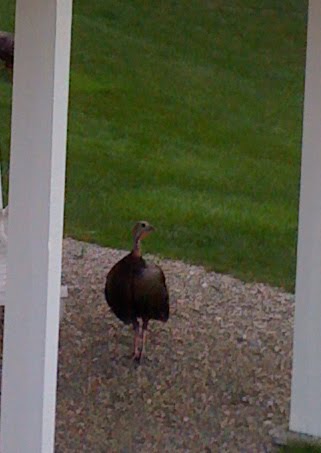
I do love seeing the turkeys near my house, but sometimes they get a bit too close for comfort. When the adult bird in the photo below began to explore under my deck, I decided to shoo it away—large birds produce large droppings and I didn't really want to have that amid the gravel. But I didn't get too close while entreating the bird to leave. I've heard a story or two about turkeys attacking people and, with the bird's children right around the corner, I thought it might be in a protective mode. Fortunately, as I approached, the turkey fled in the direction of its family.
I have to call the turkey "it" because I haven't a clue about its gender. How do you tell a male from a female turkey? Another conundrum for the uninitiated bird watcher. I can report, though, that a total of twelve babies have been accompanied during the past few weeks by three very watchful adults.
Click on the photos to enlarge them.
Wednesday, July 14, 2010
Wine With Lunch, or Not
Wine with lunch seems such a pleasant concept, but it's not one that works for me.
Today, I was a guest at a lovely 60th-birthday lunch. The setting was delightful, a whimsical Cambridge restaurant with magenta walls, accented by a riot of other colors. Before we sat down for lunch, the wait staff circulated with glasses of white wine. My hands were empty. I felt thirsty. I took a glass.
So delightful, so elegant, so likely to make me dizzy. Or drowsy. Or even give me a headache. I took a sip. That was it. After half an hour or so, we sat down to a delicious meal accompanied by good conversation. During the course of it I took one more sip of my wine. That was enough, almost too much.
Yet, had it been dinner, I surely would have enjoyed the whole glass and perhaps even indulged in a second one. The time of day seems to have a profound effect on wine's effect on me. All around me, friends imbibed, chatted, laughed, forgot the way time marches on. I forgot I hadn't had any wine and let the enjoyment of being with women I'd known for decades intoxicate me.
When it came time to leave, hugs all around, and off I went to the parking garage, along with two friends. I took out the keys to my car. Got in the driver's seat. Glad I hadn't been drinking.
Photo courtesy of Wikimedia Commons.
Today, I was a guest at a lovely 60th-birthday lunch. The setting was delightful, a whimsical Cambridge restaurant with magenta walls, accented by a riot of other colors. Before we sat down for lunch, the wait staff circulated with glasses of white wine. My hands were empty. I felt thirsty. I took a glass.
So delightful, so elegant, so likely to make me dizzy. Or drowsy. Or even give me a headache. I took a sip. That was it. After half an hour or so, we sat down to a delicious meal accompanied by good conversation. During the course of it I took one more sip of my wine. That was enough, almost too much.
Yet, had it been dinner, I surely would have enjoyed the whole glass and perhaps even indulged in a second one. The time of day seems to have a profound effect on wine's effect on me. All around me, friends imbibed, chatted, laughed, forgot the way time marches on. I forgot I hadn't had any wine and let the enjoyment of being with women I'd known for decades intoxicate me.
When it came time to leave, hugs all around, and off I went to the parking garage, along with two friends. I took out the keys to my car. Got in the driver's seat. Glad I hadn't been drinking.
Photo courtesy of Wikimedia Commons.
Subscribe to:
Posts (Atom)