The Good
I don't feel old. I don't have arthritis or other big aches and pains, at least not today. I can still do the things I care about — walking, reading, writing, and most importantly, spending time with the people I love.
I can still line dance.
I can still marvel at the beauty of the world. During the winter months I feel fortunate that I can sit on my island bench overlooking Biscayne Bay and watch the pelicans and cormorants fly by. Sometimes, I'm lucky enough to see a manatee surface for air or a spotted eagle ray leap out of the water. Mostly, though, I enjoy taking in the view with E. by my side. More than anywhere else, that bench is where I can just be in the moment.
I feel lucky to have so many terrific people in my life — wonderful family and friends who put up with me, laugh with me, and are there when I need them.
I hadn't expected the special pleasure of having adult relationships with my sons and their wives. They seem a lot smarter than me now, but I'm delighted that they still occasionally ask my opinion. Best of all, I've loved watching them become great parents to my four amazing grandchildren.
Also good — no gray hair yet.
The Bad
Health. Ill health, that is. Several friends have faced difficult health challenges during the past year. I know it comes with the territory, but it's still a daunting path to face as I meander into older age.
The specter of poor health in one's seventies is bad enough, but when serious illness strikes a young person, it's a million times worse. That happened to someone I love this year and has reminded me how cruel and arbitrary life can be.
Then there's the wider world, with the earth in crisis on every imaginable level — glaciers melting, insects disappearing, Trump tweeting, Venezuela and Yemen imploding, racism and anti-Semitism as virulent as ever. Not a very auspicious time to turn 70. (But see The Good, above — focusing on simple pleasures and loved ones really helps.)
The Ugly
With a nod to Nora Ephron, my neck. Not to mention all those other wrinkles. But here's something good — I can't get up the energy to care. Of course, that's probably because I'm 70 and don't have as much energy as I used to.
Thursday, February 14, 2019
Wednesday, September 5, 2018
Eagleton's Last Stand
![]() |
| Sylvan Lake, South Dakota |
E. and I were en route from Massachusetts to California, having gotten married a month earlier. We mostly car-camped as we drove west in our tiny Saab Sonnett, which had no AC and no radio. It's hard to imagine in today's wired world how completely out of touch we were at times.
We did know, however, that George McGovern, a senator from South Dakota, was the Democratic nominee for President and that Thomas Eagleton was his running mate. A few days before we arrived in South Dakota, we stopped in St. Paul, Minnesota, where we stayed with Eric's cousin Gail and caught up on the latest news. It was there we learned that all hell had broken loose on Tuesday, July 25th, when Eagleton revealed to McGovern that he'd been hospitalized for depression during the sixties and had twice received electroshock therapy.
![]() |
| Photo courtesy of Wikimedia Commons |
At the Mount Rushmore visitor center, I came across a pamphlet about nearby Custer State Park, which included a mention of Sylvan Lake Lodge. It sounded appealing, especially since we had spent the prior night, our one-month wedding anniversary, in our tiny tent. E. agreed that a splurge was called for and I felt a twinge of anticipation as we drove along Needles Highway toward the lodge. Though we didn't have a reservation, we couldn't imagine they wouldn't have a room for us.
As it turned out, they had plenty of rooms. McGovern and his crew had cleared out that morning and the place was almost empty. The setting of the lodge was gorgeous, having been chosen by none other than Frank Lloyd Wright, and the lodge had a rustic charm. The staff was mostly young and still filled with excitement about the political celebrities they'd just hosted. It thrilled me to realize that I was in the very place where so much political intrigue had so recently transpired. When McGovern had arrived at the lodge, only a few short days earlier, everything had seemed fine. By the time he departed, that very mornng, he had all but decided to dump Eagleton after initially standing by him.
While we didn't witness this firsthand, we did dine on buffalo meat in the same dining room where McGovern and Eagleton had eaten. We walked the same corridors where reporters had pressed the candidates for answers, and we felt the pathos of the situation all the more keenly for being in the place where it had just played out.
![]() |
| Eagleton resigns |
E. and I continued our journey across the country, lingering to marvel at the Grand Tetons, then visiting friends who lived in a tree house in the wilds of Idaho (this was, after all, the seventies). While there, we slept on a mattress under the stars, a far better accommodation than we encountered at our next stop, in the Nevada desert, where we opted for a bed-bug-infested motel rather than risk scorpions in our tent. By the time we arrived at E.'s parents' house on the Stanford campus, the Watergate coverup was well underway and Sargent Shriver was George McGovern's new running mate.
I hadn't thought about this story in years until the other day, when I found myself recounting it to a friend. Perhaps there's some lesson for our present political moment that caused it to come to mind. For me, though, it's primarily a wonderful memory of a time when I didn't worry about hotel reservations, or about what might be coming around the bend (other than scorpions), and was rewarded with a very special experience.
Tuesday, May 29, 2018
In the Crossword Zone
Something odd has happened. I've become a whiz at crossword puzzles, having completed the New York Times Crossword thirty-one days in a row, without cheating. It's almost enough to make me believe in miracles. Or maybe the Times puzzles have gotten easier. More likely, though, my newfound skill is due to my sister, Janet, and my son, Alex.
Logically, my ability to solve puzzles should have become worse as I've aged. My word recall has deteriorated and I forget the plots of novels almost as soon as I've read them. Yet, I manage to dredge up long-forgotten names and words when I'm working on a puzzle.
In part, I've improved because I've mastered certain crossword puzzle techniques. Like many frequent solvers, I now easily fill in words that are virtually only found in crosswords, never in actual speech, like etui or iambi. And when a cookie or a snack or a "sandwich often given a twist" is involved, I've learned to think of oreos.
I've also gotten much better at recognizing the different possible meanings of a clue. Take, for example, the seven-letter clue "big hits," which appeared in a recent Sunday puzzle. My first association was to successes in the arts, like a hit song or a hit film. When nothing along those lines seemed to fit, I thought maybe the hits referred to punches. Finally, I realized I should have been thinking about baseball hits — the answer was "triples". I used to become fixated on one definition of a word or phrase, which led to frustration and defeat. Now, I'm more attuned to different meanings.
The Times Crossword increases in difficulty as the week progresses, with Monday the easiest and Saturday the most difficult. In the past, I could usually complete the Monday, Tuesday, and Wednesday puzzles, but after that all bets were off. Thursday puzzles feature "tricks", which I used to find confounding. Sunday puzzles are longer, but at about a Thursday level of difficulty. Despite having learned the crossword techniques described above, I had never finished a Sunday puzzle without "cheating," which for me meant Googling to discover which Rhine tributary flows through Switzerland (Aare) or the name of a famous Verdi aria (Eri Tu). Then a casual conversation with my brother-in-law, Michael, changed all that.
We were discussing crosswords and I mentioned that I found the Times Sunday puzzles daunting.
"Really?" said Michael. "Janet always finishes them."
What? My little sister was better at crosswords than me? A competitive nerve I thought I'd long ago numbed began to twinge. I resolved to try harder at the Sunday crosswords. If Janet could do them then, by God, so could I.
And so it came to pass. My progress was slow at first, but I persisted and eventually I could almost always complete the Sunday puzzles, without cheating. And I got better at the Thursday puzzles, too. The Friday and Saturday offerings still eluded me, though. Enter my son, Alex.
When Alex was younger, he used to tell me he admired my vocabulary. Back then, he was impressed that I could finish a Monday puzzle. So imagine my surprise when, about a year ago, Alex sent me a text to let me know he had finished a Friday puzzle in under twenty minutes. I was filled with pride — my son, the genius! But wait, how had it come to this? My child, who only yesterday saw me as an accomplished puzzle solver, had surpassed me. I felt a sudden determination to master not only the Friday puzzle, but the Saturday, too.
Was I now competing with my son? Had I stooped so low? I preferred to regard myself as inspired by him, but let's call a spade a spade. Alex's accomplishment gave me the jolt I needed to go to the next level. Soon, I was solving Friday and Saturday puzzles with some regularity, and there's no doubt I was spurred on by my desire to perform at least as well as Alex.
Crossword puzzles may have brought out my latent competitiveness, but they've also awakened a couple of qualities I feel good about. The first is a can-do attitude. I used to approach every Friday puzzle convinced that I could never solve it. Now I assume the opposite. Add to that a newfound persistence, and my odds of success have vastly increased. I simply don't quit. I just stare the puzzle down and keep at it.
When I'm feeling totally stumped, I get up and do something else for a while. Often the answers to seemingly insoluble clues become obvious after a walk around the block. But if all else fails, I just think of Janet and Alex effortlessly conquering the worst that the Times Crossword can throw at them. That does the trick every time.
Logically, my ability to solve puzzles should have become worse as I've aged. My word recall has deteriorated and I forget the plots of novels almost as soon as I've read them. Yet, I manage to dredge up long-forgotten names and words when I'm working on a puzzle.
![]() |
| An antique French etui |
I've also gotten much better at recognizing the different possible meanings of a clue. Take, for example, the seven-letter clue "big hits," which appeared in a recent Sunday puzzle. My first association was to successes in the arts, like a hit song or a hit film. When nothing along those lines seemed to fit, I thought maybe the hits referred to punches. Finally, I realized I should have been thinking about baseball hits — the answer was "triples". I used to become fixated on one definition of a word or phrase, which led to frustration and defeat. Now, I'm more attuned to different meanings.
The Times Crossword increases in difficulty as the week progresses, with Monday the easiest and Saturday the most difficult. In the past, I could usually complete the Monday, Tuesday, and Wednesday puzzles, but after that all bets were off. Thursday puzzles feature "tricks", which I used to find confounding. Sunday puzzles are longer, but at about a Thursday level of difficulty. Despite having learned the crossword techniques described above, I had never finished a Sunday puzzle without "cheating," which for me meant Googling to discover which Rhine tributary flows through Switzerland (Aare) or the name of a famous Verdi aria (Eri Tu). Then a casual conversation with my brother-in-law, Michael, changed all that.
![]() |
| The Aare River at Bern, Switzerland |
"Really?" said Michael. "Janet always finishes them."
What? My little sister was better at crosswords than me? A competitive nerve I thought I'd long ago numbed began to twinge. I resolved to try harder at the Sunday crosswords. If Janet could do them then, by God, so could I.
And so it came to pass. My progress was slow at first, but I persisted and eventually I could almost always complete the Sunday puzzles, without cheating. And I got better at the Thursday puzzles, too. The Friday and Saturday offerings still eluded me, though. Enter my son, Alex.
When Alex was younger, he used to tell me he admired my vocabulary. Back then, he was impressed that I could finish a Monday puzzle. So imagine my surprise when, about a year ago, Alex sent me a text to let me know he had finished a Friday puzzle in under twenty minutes. I was filled with pride — my son, the genius! But wait, how had it come to this? My child, who only yesterday saw me as an accomplished puzzle solver, had surpassed me. I felt a sudden determination to master not only the Friday puzzle, but the Saturday, too.
Was I now competing with my son? Had I stooped so low? I preferred to regard myself as inspired by him, but let's call a spade a spade. Alex's accomplishment gave me the jolt I needed to go to the next level. Soon, I was solving Friday and Saturday puzzles with some regularity, and there's no doubt I was spurred on by my desire to perform at least as well as Alex.
Crossword puzzles may have brought out my latent competitiveness, but they've also awakened a couple of qualities I feel good about. The first is a can-do attitude. I used to approach every Friday puzzle convinced that I could never solve it. Now I assume the opposite. Add to that a newfound persistence, and my odds of success have vastly increased. I simply don't quit. I just stare the puzzle down and keep at it.
When I'm feeling totally stumped, I get up and do something else for a while. Often the answers to seemingly insoluble clues become obvious after a walk around the block. But if all else fails, I just think of Janet and Alex effortlessly conquering the worst that the Times Crossword can throw at them. That does the trick every time.
Sunday, April 15, 2018
Bald Eagle
It happened in the unlikeliest of places, at the unlikeliest of moments. E. and I were driving home from New York after spending the weekend with our kids and grandkids. We decided to stop for gas and a bite to eat in Glastonbury, Connecticut, a pretty town along our route. It was early evening and the light was just starting to fade. As we pulled into the gas station, I glanced out the car's front window.
Above me soared a bird with an impressive wing-span, whose wings themselves appeared black against the blue sky, and whose head looked as white as Bill Clinton's hair. Clinton's hair comes to mind because the day before, while exploring the little village of Pleasantville, NY, we had encountered the former President at a local bookstore, where he was holding forth on politics to a couple of random customers. His hair looked very white.
But I digress. The moment I saw the bird, I knew it was a bald eagle — wild, free, and for some reason searching for prey above a gas station in the commercial district of a manicured suburb. I had last seen a bald eagle twenty years earlier, in Juneau, Alaska, where they are common. But I'd never seen one on the East Coast.
I felt joyful, as if I had achieved something special by my mere proximity to such a magnificent creature. I knew that bald eagles are part scavengers, an attribute not in keeping with their lofty reputation, but at that moment I saw nothing but the bird's noble countenance. The incongruity of the setting made the experience all the more thrilling.
By the time E. had filled the tank, the bird was gone. I checked my Cornell Ornithology Lab's Merlin app to see what else I might learn about the bald eagle and its presence in this quiet part of Connecticut. I discovered that the adult's wings are dark brown, though they had appeared black from my vantage point. Further, bald eagles inhabit areas near lakes, reservoirs, and rivers. The Connecticut River runs through Glastonbury and might explain the bird's presence nearby.
The eagle had departed but the feeling of joy stayed with me for a long while. Worries big and small receded. Everything around me seemed more vivid and beautiful. Sort of like how Bill Clinton looked larger than life in that little bookstore, though I wouldn't go so far as to call him beautiful.
I love birds and I enjoy watching them. Over the years, I've learned to identify quite a few species. However, I don't think of myself as a "bird watcher." I don't keep a life list, nor do I go hiking at ungodly hours in search of new sightings. But like many birders, I'm grateful that I share this world with bald eagles and all the other amazing bird species. With the possible exception of pigeons.
![]() |
| Photo by Kate Wellington |
But I digress. The moment I saw the bird, I knew it was a bald eagle — wild, free, and for some reason searching for prey above a gas station in the commercial district of a manicured suburb. I had last seen a bald eagle twenty years earlier, in Juneau, Alaska, where they are common. But I'd never seen one on the East Coast.
I felt joyful, as if I had achieved something special by my mere proximity to such a magnificent creature. I knew that bald eagles are part scavengers, an attribute not in keeping with their lofty reputation, but at that moment I saw nothing but the bird's noble countenance. The incongruity of the setting made the experience all the more thrilling.
By the time E. had filled the tank, the bird was gone. I checked my Cornell Ornithology Lab's Merlin app to see what else I might learn about the bald eagle and its presence in this quiet part of Connecticut. I discovered that the adult's wings are dark brown, though they had appeared black from my vantage point. Further, bald eagles inhabit areas near lakes, reservoirs, and rivers. The Connecticut River runs through Glastonbury and might explain the bird's presence nearby.
![]() |
| Photo by Saffron Blaze |
I love birds and I enjoy watching them. Over the years, I've learned to identify quite a few species. However, I don't think of myself as a "bird watcher." I don't keep a life list, nor do I go hiking at ungodly hours in search of new sightings. But like many birders, I'm grateful that I share this world with bald eagles and all the other amazing bird species. With the possible exception of pigeons.
Friday, March 16, 2018
Where Am I?
Years ago, while in Miami, I started listening on my iPhone apps to WBUR and WGBH, the Boston public radio stations. Sometimes, I'm listening to a Boston radio station and the announcer begins describing blizzard conditions. I feel confused. Where am I? It takes me a minute to realize that if I step onto my terrace it will be seventy degrees and sunny.
When I'm back up north, I keep part of my psyche in Miami by listening to WLRN, South Florida's public radio station. There, I get updates on the latest local news, plus notices about cultural happenings, all delivered by an incongruously British-accented announcer. And during football season, WQAM, a Miami AM radio station, keeps me dialed into the University of Miami Hurricanes games, complete with the two wackiest sportscasters I've ever heard.
In Miami, E. and I live in an apartment, while in Boston we share a house. The living spaces couldn't be more different. However, we've tried to replicate our belongings, so that one place feels as much like the other as possible. Our idea has been to create a seamless transition when we travel between our two homes.
We have the same sleep number mattresses in both places, the same desktop computers, the same television sets, even the same thermostats. We would have purchased the same flatware, but for some reason our stainless steel pattern (purchased in 1972) was no longer available. We did go wild with our dishes, though. Our set up north is solid white, but for our Miami condo we chose a pattern with a white background and black stripes around the rims.
I could go on, but you get the picture — E. and I don't do well with change. We're homebodies and we like our two homes to feel like one. If the winters weren't quite so severe up north, we would never have thought about spending the cold months elsewhere. Yet, despite our best efforts to set up identical lives in both places, I feel completely different when I'm in Miami than when I'm in Boston.
That's not so surprising, given how different the two cities are. Miami's vibe is exotic and flamboyant, while Boston feels more intellectual and grounded. But here's what does surprise me — I love both places! I especially love that they're different. That's a good thing, right? Of course it is, but it also makes leaving either place hard.
This year has been particularly difficult. We had said goodbye to our friends in Miami and had made plans back in Boston when the weather intervened, with a major nor'easter threatening. American Airlines even offered to waive our change fees. So, we postponed our departure for several days.
The storm has come and gone and I'm still in Miami, in limbo. It feels odd, but oddly comforting. My bags are packed and I'm not unpacking them. E. and I have made new plans with the friends to whom we already said goodbye. And I'm enjoying the gorgeous weather here, although it doesn't feel quite real, since I know I'll soon be back in chilly Boston.
So, where am I? I'm not home yet, but I'm home.
Monday, January 22, 2018
I Don't Like It, But Is It Good?
In the spring of 1968, when I was a freshman in college, I went to an Archie Shepp concert with my then-boyfriend, Peter. A bus picked us up in front of Converse Hall at Amherst College and took us to Springfield, Massachusetts for the performance.
Among the crowd waiting for the bus, I noticed E., whom I'd met earlier that year, when he was dating a girl in my dorm at Smith College. I remember saying hello to him before we got on the bus. I knew he was a musician, but not much else.
I didn't enjoy the concert. Shepp played in a style that combined avant-garde free jazz techniques with African rhythms. To me, the result sounded like a discordant mess. I could tell that Shepp was very skilled on his instrument, the saxophone, but I couldn't relate to what he was playing. Yet, I knew he was regarded as talented and innovative by jazz critics. I wondered what was wrong with me, that I didn't like him.
On the return bus trip, I got into an argument with Peter. He hadn't liked Shepp, either. But I insisted that just because we hadn't enjoyed the music, that didn't mean it wasn't good. Maybe it meant our taste wasn't developed enough to appreciate Shepp's talent.
I saw E. sitting a few rows ahead of me on the bus. Knowing he was a musician, I imagined that he had appreciated Shepp's skills at some higher level. I wished I had gone to the concert with him, so he could have explained the music to me.
By 1972, E. and I were living together. He had a large record collection and we wiled away many hours listening to all kinds of music. I hoped E. would help me develop good taste. I was still plagued by the worry that when I didn't enjoy music admired by critics, it was because I was too much of philistine to appreciate the finer things in life.
One afternoon, E. played a Miles Davis album from Davis' abstract period. Although I didn't know much about jazz at the time, I did know that Miles Davis was an icon of the genre. Yet, as with Archie Shepp, though I could tell Davis was a masterful musician, I didn't enjoy the music. Davis' cool improvisations kept veering away from anything melodic, which I yearned for. The album definitely put me in a groove, but it was a pretty depressed groove. And, once again, I blamed myself for failing to "get it."
"Is this good?" I asked E.
"Do you like it?" he replied.
"Not really," I acknowledged. "But that's probably because I'm too dense to understand what I'm hearing."
E. disagreed. He felt that what mattered was how I innately responded to the music.
"If you don't like it, why force yourself to listen to it?" he said.
Not long after this conversation, we moved to California, where E. got a job as a music critic for the Palo Alto Times. I accompanied him to many performances and heard everyone from Count Basie, Oscar Peterson, and Ella Fitzgerald to Cecil Taylor, Chick Corea, Herbie Hancock, and Vince Guaraldi. Between hours of listening and hours of talking about the performances with E., I finally got the musical education I'd longed for. I came to appreciate and even enjoy some types of jazz, particularly jazz-funk, with its strong rhythms and catchy riffs.
It took a while, but ultimately I stopped worrying about what other people might think of my musical taste and listened to the artists I enjoyed. Here are a few examples of jazz performances from the seventies that I loved the first time I heard them and still love today. You may not agree, but of course I'll understand — it's all about what sounds good to you.
Eumir Deodato's "Also Sprach Zarathustra (2001)," from his album, Prelude:
Among the crowd waiting for the bus, I noticed E., whom I'd met earlier that year, when he was dating a girl in my dorm at Smith College. I remember saying hello to him before we got on the bus. I knew he was a musician, but not much else.
![]() |
| Archie Shepp, Lecco, Italy, 1967 |
On the return bus trip, I got into an argument with Peter. He hadn't liked Shepp, either. But I insisted that just because we hadn't enjoyed the music, that didn't mean it wasn't good. Maybe it meant our taste wasn't developed enough to appreciate Shepp's talent.
I saw E. sitting a few rows ahead of me on the bus. Knowing he was a musician, I imagined that he had appreciated Shepp's skills at some higher level. I wished I had gone to the concert with him, so he could have explained the music to me.
By 1972, E. and I were living together. He had a large record collection and we wiled away many hours listening to all kinds of music. I hoped E. would help me develop good taste. I was still plagued by the worry that when I didn't enjoy music admired by critics, it was because I was too much of philistine to appreciate the finer things in life.
One afternoon, E. played a Miles Davis album from Davis' abstract period. Although I didn't know much about jazz at the time, I did know that Miles Davis was an icon of the genre. Yet, as with Archie Shepp, though I could tell Davis was a masterful musician, I didn't enjoy the music. Davis' cool improvisations kept veering away from anything melodic, which I yearned for. The album definitely put me in a groove, but it was a pretty depressed groove. And, once again, I blamed myself for failing to "get it."
"Is this good?" I asked E.
"Do you like it?" he replied.
"Not really," I acknowledged. "But that's probably because I'm too dense to understand what I'm hearing."
E. disagreed. He felt that what mattered was how I innately responded to the music.
"If you don't like it, why force yourself to listen to it?" he said.
Not long after this conversation, we moved to California, where E. got a job as a music critic for the Palo Alto Times. I accompanied him to many performances and heard everyone from Count Basie, Oscar Peterson, and Ella Fitzgerald to Cecil Taylor, Chick Corea, Herbie Hancock, and Vince Guaraldi. Between hours of listening and hours of talking about the performances with E., I finally got the musical education I'd longed for. I came to appreciate and even enjoy some types of jazz, particularly jazz-funk, with its strong rhythms and catchy riffs.
It took a while, but ultimately I stopped worrying about what other people might think of my musical taste and listened to the artists I enjoyed. Here are a few examples of jazz performances from the seventies that I loved the first time I heard them and still love today. You may not agree, but of course I'll understand — it's all about what sounds good to you.
Eumir Deodato's "Also Sprach Zarathustra (2001)," from his album, Prelude:
Hampton Hawes' "Go Down Moses," from his album, Northern Windows, with the inimitable Carol Kaye on bass:
Keith Jarrett's "The Rich (And the Poor)," from his album, Treasure Island:
Labels:
Amherst College,
Eumir Deodato,
funk,
Hampton Hawes,
jazz,
Keith Jarrett,
Palo Alto Times
Tuesday, December 26, 2017
Keeping the Memories Fond
On a late summer weekend in September, I was a no-show at the 50th reunion of my South Side High School class. I had a bad cold and an unsightly stye, so I certainly wouldn't have looked or felt my best, but in fact I had already decided not to attend.
I've long been conflicted about reunions. I'm never sure whether I'll feel uplifted, let down, or simply bored, so I usually take the path of least resistance and don't go. But my 50th seemed like a bigger deal than most, since it would almost certainly be the last time I'd have the chance to reunite with my classmates from long ago.
The only high school reunion I ever attended was my 20th. I brought E. along with me to Rockville Centre, on Long Island. I wanted him to meet the people I'd talked about for years. And, to be honest, I wanted him there for support and a reality check. I was afraid that without him to ground me I might quickly revert to my insecure teenage state.
When E. and I arrived at the hotel where my 20th was held, the first people I saw were Ronnie, Ellie, and Andi — the popular girls of my youth. I had worked hard to make them my friends. They screamed. I screamed. We embraced, we giggled, we all talked at once. They looked me up and down, no doubt to see how I had turned out. I did the same to them.
Ronnie still had an adorable dimple in her cheek, but what was with all the makeup? I reminded myself that she lived in Texas now. Ellie seemed much as I remembered her, my favorite among them, still cute with her curly hair, still bubbly and affectionate. Andi, still single and still a redhead, had become a personal shopper and had beautifully curated her outfit for the occasion. My dress suddenly seemed dowdy. But, I told myself, she doesn't have a husband and I do.
Oh my God, had I really thought that? I had reacted like an insecure, snarky, mean girl. Even with E. standing stoically by my side, I'd fallen right back into that angst-ridden state that had marked and marred my teenage years.
Turning around, I saw Warren, sporting a deep tan. I'd had a crush on him in junior high school and we even dated for a little while. The high point of our relationship came when he took me to our 9th grade prom. The gardenia wrist corsage he gave me smelled heavenly, but the flower faded fast. Just like our relationship. I had nothing to say to him in junior high, which at the time I thought was my fault. When he greeted me at our 20th the same way he had in the 9th grade — Hey, Barbara baby — I realized that I still had nothing to say to him.
He did look handsome, though, despite having less hair. But I almost felt sad for him when a classmate told me he had taken the day before the reunion off from work so he could go to the beach and perfect his suntan. Who does that? I wondered. But, secretly, I knew — I did. Like Warren, I wanted to look perfect for the reunion, or at least as good as I had in high school. And I wanted to convince everyone that I had turned out well.
That's when having E. with me really helped. It reminded me that I actually had turned out okay and, furthermore, that I'd found someone I could talk to, someone who was smart, kind, and loving. He even had all his hair!
Despite my alarming regression into teenage angst, I was glad I'd attended my 20th. I had genuinely wanted to see Ronnie, Ellie, and Andi again. I'd been curious how they'd turned out. And I had enjoyed introducing E. to them and to many other classmates he'd heard about.
![]() |
| Vintage jacket at sported at the South Side 50th. |
It had been thirty years since I'd seen most of my classmates. It seemed like another life. Yet, I found myself wondering about them, just a little. How had they aged? What were they up to? Would they still seem like the people I once knew? I wasn't sure I wanted to find out.
One of my classmates emailed me and tried to convince me to attend. He even procured the list of those who had registered for the event — fewer than 60 people from a class of 300. Where were the others? They couldn't all have died, could they? Maybe they, like me, felt disconnected from that long-ago time. I decided that I preferred to remember my classmates, fondly, as they'd been back then, and elected not to go.
Just yesterday, the classmate who tried to persuade me to attend the reunion emailed me again. He sent photographs of the event and even included a "cheat sheet," so I could figure out who all those old people were. I didn't need it to recognize Ronnie, with her dimple still intact, Ellie, looking sweet as always, and Andi, in a glamorous black dress. It was great fun seeing the pictures and it almost made me wish I'd been there. But not with a runny nose and an ugly stye.
Labels:
high school,
reunion,
Rockville Centre,
South Side
Monday, November 20, 2017
The (Very) Dark Side of Technology
Just when I thought I'd captured the market on worrying, E. sent me a video that makes my anxieties seem trivial. The video was created by Stuart Russell, a professor at UC Berkeley, in collaboration with the Future of Life Institute. It was shown earlier this month in Geneva, Switzerland at a United Nations meeting of the Convention on Certain Conventional Weapons. The video presents a grim fantasy about the unintended consequences of developing weaponized drones that use artificial intelligence. It's meant to scare the sh*t out of us and, for me at least, it worked.
Earthquakes, floods, hurricanes, even nuclear war pale in comparison to the dystopian future pictured in the video. Okay, nuclear war can't really pale in comparison to anything, but this scenario is about as close as it gets.
While technology has increased our ability to do good, some people inevitably seek to exploit it for evil ends. E. and I often speculate about the coming rise of machines and we wonder whether artificial intelligence will take over the world. Sometimes I even imagine that, given the destructive history of our species, machines would do a better job.
The video, though, pictures a world where humans are still in charge, one in which terrorists appropriate technology originally intended for fighting criminals and use it to further their malevolent goals. Professor Russell hopes the video will galvanize the world into action to prevent the scenario it depicts. But he cautions that time is running out.
Watch the video if you dare. And on Thanksgiving day, be thankful that the murderous drones depicted in it haven't been unleashed, yet.
Earthquakes, floods, hurricanes, even nuclear war pale in comparison to the dystopian future pictured in the video. Okay, nuclear war can't really pale in comparison to anything, but this scenario is about as close as it gets.
The first drone I saw up close, during the innocent
days when small drones were only used for things
like real estate photography.
|
The video, though, pictures a world where humans are still in charge, one in which terrorists appropriate technology originally intended for fighting criminals and use it to further their malevolent goals. Professor Russell hopes the video will galvanize the world into action to prevent the scenario it depicts. But he cautions that time is running out.
Watch the video if you dare. And on Thanksgiving day, be thankful that the murderous drones depicted in it haven't been unleashed, yet.
Monday, November 13, 2017
Coconuts
Long before I ever imagined living in a place called Coconut Grove, I heard an unfortunate story about a coconut. It was told to me by Herb, a family friend, and it came to mind recently, as I gazed at the coconut palms still standing on my hurricane-ravaged island.
I was visiting my parents, who lived in Boca Raton. I had arrived a few days earlier from mid-winter Boston after a nasty bout with the flu. Herb, who lived nearby, had come over to say hello. I told him how wonderful Florida's warm, humid air felt and mentioned that I had been especially enjoying evening strolls under the palm trees in my parents' neighborhood.
"Be careful about the coconut palms," said Herb. "A friend of mine was taking a walk and a coconut fell on his head and killed him."
Not a reassuring story for a worrier like me. It had never occurred to me to fret about walking under palm trees. But Herb's cautionary tale stayed with me. His friend's death seemed like a particularly embarrassing way to go — one minute you're living in an earthly paradise, the next you're done in by a coconut.
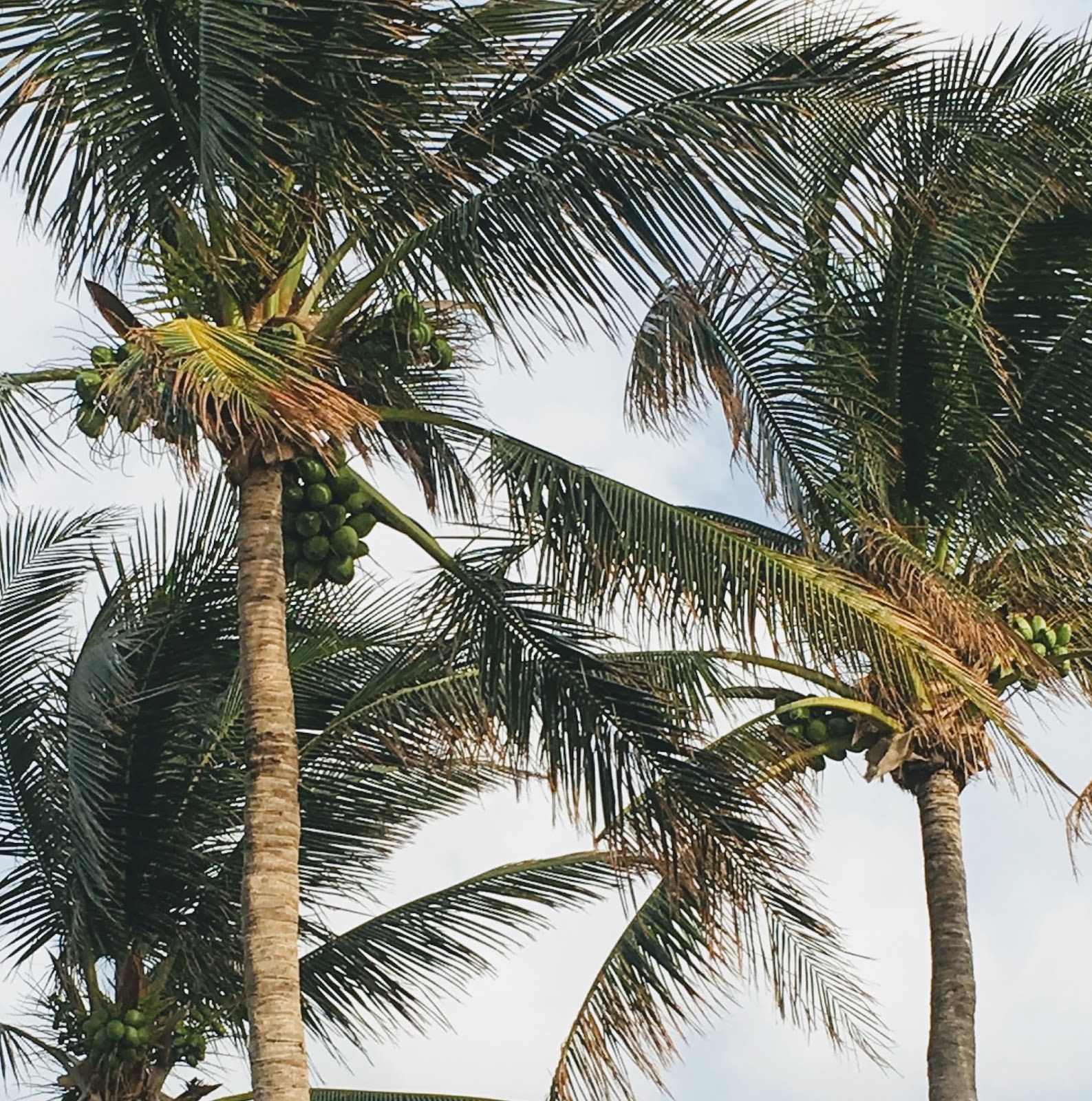
The island where I live has many coconut palms. As I detailed in my last post, virtually all of them survived Hurricane Irma. So did the bunches of coconuts hanging from each tree, and they have continued to grow and ripen during the weeks since the hurricane. Normally, the landscape crew that takes care of the island removes the ripening fruit before it can reach the stage where a gust of wind or its own weight could bring it down, but with so much cleanup needed after the storm, coconut removal apparently hasn't been a priority. Individual coconuts have begun falling to the ground, causing me to worry that even a gentle breeze might send one flying in my direction.
At first, during my daily walks, when I approached a stand of coconut palms overhanging the path, I would lean my head back to see if anything was about to fall on me. Not a brilliant approach, since anything that did fall would then smash me in the face, an even worse fate than being beaned on the top of my head. So, for the past few days, when in the vicinity of hanging coconuts, I've taken to walking with both hands on my head. This detracts from the impression I'd like to give my fellow residents — that I'm a laid back sophisticate from up north — but I'm hoping it will diminish the impact of a fallen fruit on my skull.
A few days ago, attempting nonchalance, I mentioned the coconut situation to a neighbor and was relieved to learn that I wasn't the only one who had noticed the coconuts and worried about them. According to my neighbor, the condo's landscape committee had asked the landscape crew to remove them as soon as possible.
This morning, the crew arrived with two bucket trucks and began working on the palm trees. Inexplicably, they've chosen to start by removing dead fronds from the palm trees that line the road through the community even though those are not coconut palms and pose no threat to walkers. Still, I'm not complaining — only a few more days of walking with my hands on my head and I should be able to relax.
Note: Click on the photos to enlarge them.
"Be careful about the coconut palms," said Herb. "A friend of mine was taking a walk and a coconut fell on his head and killed him."
Not a reassuring story for a worrier like me. It had never occurred to me to fret about walking under palm trees. But Herb's cautionary tale stayed with me. His friend's death seemed like a particularly embarrassing way to go — one minute you're living in an earthly paradise, the next you're done in by a coconut.
* * *
The island where I live has many coconut palms. As I detailed in my last post, virtually all of them survived Hurricane Irma. So did the bunches of coconuts hanging from each tree, and they have continued to grow and ripen during the weeks since the hurricane. Normally, the landscape crew that takes care of the island removes the ripening fruit before it can reach the stage where a gust of wind or its own weight could bring it down, but with so much cleanup needed after the storm, coconut removal apparently hasn't been a priority. Individual coconuts have begun falling to the ground, causing me to worry that even a gentle breeze might send one flying in my direction.
At first, during my daily walks, when I approached a stand of coconut palms overhanging the path, I would lean my head back to see if anything was about to fall on me. Not a brilliant approach, since anything that did fall would then smash me in the face, an even worse fate than being beaned on the top of my head. So, for the past few days, when in the vicinity of hanging coconuts, I've taken to walking with both hands on my head. This detracts from the impression I'd like to give my fellow residents — that I'm a laid back sophisticate from up north — but I'm hoping it will diminish the impact of a fallen fruit on my skull.
A few days ago, attempting nonchalance, I mentioned the coconut situation to a neighbor and was relieved to learn that I wasn't the only one who had noticed the coconuts and worried about them. According to my neighbor, the condo's landscape committee had asked the landscape crew to remove them as soon as possible.
This morning, the crew arrived with two bucket trucks and began working on the palm trees. Inexplicably, they've chosen to start by removing dead fronds from the palm trees that line the road through the community even though those are not coconut palms and pose no threat to walkers. Still, I'm not complaining — only a few more days of walking with my hands on my head and I should be able to relax.
Note: Click on the photos to enlarge them.
Sunday, November 5, 2017
Lonely Palms
Since I last posted on this blog, our country has been through a lot — winds, floods, fires, political tempests. Although I’ve agonized from afar, nothing directly affected me until Hurricane Irma made landfall on my beloved island just off the coast of Miami.
I was in New England as the storm approached. When meteorologists predicted that a category four storm might decimate Miami, I reacted philosophically. E. and I had been lucky to have a winter getaway in such a lovely spot. If our apartment were destroyed, I would be sad, but I would move on. I did worry, though, about friends who were in the path of the storm. The island was under mandatory evacuation, but many of those who left elected to stay with friends a short distance away. They were vulnerable.
| Landscaped path and our favorite bench before the storm. |
Then Irma’s track veered and Miami suffered only a glancing blow from the hurricane’s outer bands. I breathed a sigh of relief. Not that those outer bands were completely insignificant. They still brought category one winds and a storm surge that covered the island as well as downtown Miami and Coconut Grove. But this year, everything is relative. Compared to the havoc Irma caused in the Caribbean and Maria later brought to Puerto Rico, Miami’s mess seemed small and reparable.
To be sure, there was damage on the island, according to friends’ reports — trees and foliage destroyed, the seawall partially collapsed, some apartments flooded. But the buildings did fine overall and our apartment was untouched. Power was restored after only one day and the AC worked fine. I breathed a sigh of relief. E. and I could return to Miami for another winter.
| Trees gone as well as our favorite bench. |
| Seawall collapse. |
A minor inconvenience, to put it mildly. But one whose very insignificance made me reflect on how fine the line is between normal life and total catastrophe. In an instant, the clear path of one’s life can disappear, swallowed up by illness, terrorism, natural disaster, or random accident. For today, at least, I’m grateful for what I still have — family, friends, and a spectacular view.
Friday, July 22, 2016
The High Points of the Republican Convention
People will no doubt be discussing the high points of the Convention and arguing about them for days — after all, one person's high point is surely another's low. Take Ted Cruz's non-endorsement of Donald Trump during his Convention speech. To a Trump supporter, Cruz's snub brought the political discord to an all-time low, yet to a die-hard Never-Trumper it may have been the Convention's finest moment.
I'll let the pundits ponder all that. I'd rather focus on the Trump women and the impact of their convention speeches. I don't mean the bruhaha over Melania's plagiarism or the daughterly love displayed by Tiffany and Ivanka. While all that was mildly interesting, let's get real — the most fascinating aspect of their appearances, the absolute high points, were their ridiculously high stiletto heels.
I'm amazed that they managed to walk to the podium in those heels and stand tall during their speeches with nary a whimper of discomfort, let alone a grimace of pain. You may find my focus on women's shoes highly superficial, but I beg to differ. What could be a more important subject than women's continued subjugation to their footwear?
Admittedly, I'm one of those unfortunate women whose feet have never felt good in high heels. Were I to walk a few steps in Melania's Christian Louboutin's, let alone a mile in her shoes, I would be crippled for life.
I didn't expect things to turn out that way. My mother loved wearing heels, the higher the better, so much so that her Achilles tendon shortened and made it uncomfortable for her to wear flats. As a girl, this seemed to me the height of sophistication and I always assumed I would follow in her footsteps.
Alas, I inherited the dysfunctional feet of my aunt and grandmother. By the time I was a teenager, I had to give up my dream of spike-heeled glamour in favor of sensible, low-heeled, round-toed shoes. Luckily, I came of age in the late sixties, when the women's lib movement made sensible footwear all the rage, so I was able to camouflage my disability within then-stylish comfortable designs.
During the mid-seventies, I became an early-adopter of orthotics. They saved my feet, although of course they could only be worn in the most utilitarian of shoes. By the time women's heels began to climb back into the stratosphere, I wasn't tempted. I'd come to appreciate comfort over beauty. Yet, I'd never quite gotten over my regret at not being able to wear stilettos. In the late-nineties, Sex and the City fueled my fantasies of the life I might have lived if only I'd been born with different feet.
These days, images of fabulous footwear are everywhere — from the film stars on the Academy Awards runway to Robin Wright as the House of Cards' ice queen in heels. So, I wasn't really surprised when the Trump women strode onto the stage wearing dangerous-looking, sexy five-inch heels. Still, was this appropriate for a Republican gathering? Shouldn't they have worn something a little more staid?
Maybe, but truth be told, I was jealous. All three women had the air of females who had never had a foot pain in their lives. If they couldn't empathize with aching feet, I wondered, how could they possibly relate to the average voter? I was caught in a paradox — I simultaneously disapproved of the Trump trio and envied them. Never mind that along with eschewing high heels, I don't like wearing makeup, nail polish, or even Spanx. It's not as if there but for high heels go I.
Perhaps I should forget footwear and focus on the upcoming election. I'm looking forward to the Democratic Convention. But while I wait for it to begin, I can't help but wonder — how high will Chelsea's heels go?
![]() |
| Melania. Photo from the L.A. Times. |
I'm amazed that they managed to walk to the podium in those heels and stand tall during their speeches with nary a whimper of discomfort, let alone a grimace of pain. You may find my focus on women's shoes highly superficial, but I beg to differ. What could be a more important subject than women's continued subjugation to their footwear?
![]() |
| Tiffany. Photo from Hollywood Life. |
I didn't expect things to turn out that way. My mother loved wearing heels, the higher the better, so much so that her Achilles tendon shortened and made it uncomfortable for her to wear flats. As a girl, this seemed to me the height of sophistication and I always assumed I would follow in her footsteps.
Alas, I inherited the dysfunctional feet of my aunt and grandmother. By the time I was a teenager, I had to give up my dream of spike-heeled glamour in favor of sensible, low-heeled, round-toed shoes. Luckily, I came of age in the late sixties, when the women's lib movement made sensible footwear all the rage, so I was able to camouflage my disability within then-stylish comfortable designs.
During the mid-seventies, I became an early-adopter of orthotics. They saved my feet, although of course they could only be worn in the most utilitarian of shoes. By the time women's heels began to climb back into the stratosphere, I wasn't tempted. I'd come to appreciate comfort over beauty. Yet, I'd never quite gotten over my regret at not being able to wear stilettos. In the late-nineties, Sex and the City fueled my fantasies of the life I might have lived if only I'd been born with different feet.
![]() |
| Ivanka. Photo from the New York Post. |
Maybe, but truth be told, I was jealous. All three women had the air of females who had never had a foot pain in their lives. If they couldn't empathize with aching feet, I wondered, how could they possibly relate to the average voter? I was caught in a paradox — I simultaneously disapproved of the Trump trio and envied them. Never mind that along with eschewing high heels, I don't like wearing makeup, nail polish, or even Spanx. It's not as if there but for high heels go I.
Perhaps I should forget footwear and focus on the upcoming election. I'm looking forward to the Democratic Convention. But while I wait for it to begin, I can't help but wonder — how high will Chelsea's heels go?
Labels:
feet,
high heels,
Ivanka Trump,
Melania Trump,
stilettos,
Tiffany Trump
Tuesday, April 12, 2016
Older, But Still Walking
I took a walk yesterday morning. It was a beautiful day, but cold, the temperature barely above forty degrees. So, I bundled up in a parka warm enough for a blizzard, a thick scarf, gloves, and of course my special sunglasses with wind shields. Do I look a little odd in those glasses? Yes, but if it's cold and windy, or even a bit breezy, without them my left eye will start tearing in a nanosecond and soon I'll be crying a river. They aren't prescription lenses, however, so while I may not have tears streaming down my face, I can barely see where I'm going.
I realize that, like me, some young people suffer from dry eyes, which paradoxically can cause excess tearing. They may also resort to special glasses like mine. But since I developed dry eyes later in life, I regard the glasses as a sign of approaching decrepitude. Next thing you know, I'll barely be able to walk.
Come to think of it, only a few weeks ago I was barely able to walk. I sprained my big toe while standing on my tiptoes to give my son, Aaron, a hug. He's not even that much taller than me, but all it took was a slight hyperextension of my toe to produce a piercing pain. Luckily, Aaron was just leaving for the airport after a lovely visit, so I didn't have to face the indignity of hobbling around in front of him for days, all because I hugged him too enthusiastically.
Was this toe mishap yet another sign of encroaching old age? A quick google of my symptoms indicated that I most likely had a mild case of turf toe, an injury common to young athletes, especially those who, like football players, constantly push off with their toes, especially on astroturf. So, okay, this could happen to anyone. But, it happened to me when I wasn't doing anything remotely athletic, except over-bending my slightly arthritic toe. Even if it didn't occur because I'm older, it certainly made me feel old.
I'm able to walk normally now, but every once in a while I get a twinge, a reminder that I could re-injure my toe all over again. Maybe that's a good definition of life over 65 — a time when the most trivial of injuries seems destined to lead to total disability and inevitable demise. Stating the obvious, my demise is inevitable, but while I once assumed that I'd bounce back from even serious illness, now the most minor ailments convince me that it's all downhill from here.
Yesterday, though, I felt hale and hearty enough to brave the elements and walk for several miles. My toe didn't throb even once and my glasses did their job admirably. I passed several wild turkeys during my perambulation and none of them attacked me. All in all, it was a delightful outing. I may be older, but I'm still walking.
I realize that, like me, some young people suffer from dry eyes, which paradoxically can cause excess tearing. They may also resort to special glasses like mine. But since I developed dry eyes later in life, I regard the glasses as a sign of approaching decrepitude. Next thing you know, I'll barely be able to walk.
Come to think of it, only a few weeks ago I was barely able to walk. I sprained my big toe while standing on my tiptoes to give my son, Aaron, a hug. He's not even that much taller than me, but all it took was a slight hyperextension of my toe to produce a piercing pain. Luckily, Aaron was just leaving for the airport after a lovely visit, so I didn't have to face the indignity of hobbling around in front of him for days, all because I hugged him too enthusiastically.
Was this toe mishap yet another sign of encroaching old age? A quick google of my symptoms indicated that I most likely had a mild case of turf toe, an injury common to young athletes, especially those who, like football players, constantly push off with their toes, especially on astroturf. So, okay, this could happen to anyone. But, it happened to me when I wasn't doing anything remotely athletic, except over-bending my slightly arthritic toe. Even if it didn't occur because I'm older, it certainly made me feel old.
I'm able to walk normally now, but every once in a while I get a twinge, a reminder that I could re-injure my toe all over again. Maybe that's a good definition of life over 65 — a time when the most trivial of injuries seems destined to lead to total disability and inevitable demise. Stating the obvious, my demise is inevitable, but while I once assumed that I'd bounce back from even serious illness, now the most minor ailments convince me that it's all downhill from here.
Yesterday, though, I felt hale and hearty enough to brave the elements and walk for several miles. My toe didn't throb even once and my glasses did their job admirably. I passed several wild turkeys during my perambulation and none of them attacked me. All in all, it was a delightful outing. I may be older, but I'm still walking.
Friday, January 1, 2016
Would It Help?
I recently saw the excellent film, Bridge of Spies. In the movie, which is based on a true story, Tom Hanks plays a lawyer, James Donovan, who defends Rudolf Abel, a Russian spy. A couple of lines from the movie particularly resonated with me. Given the title of this blog post, you won't be surprised which ones.
When Donovan meets Abel shortly after his arrest. Abel seems calm and unconcerned about his dire situation. Donovan, perplexed by this, asks, "Aren't you worried?" Abel replies, "Would it help?" This exchange becomes a humorous refrain throughout the film. Later, Donovan asks more pointedly, "Do you never worry?" Abel's reply is still the same.
These exchanges are oddly endearing and signal a growing respect between the two men. To me, they also signal an unattainable state of mind. If only I could make a decision not to worry and stick with it for more than a nanosecond.
After I saw the film, I found myself imagining the life of a spy. Clearly, not being a worrier would help. Spies, after all, live in constant danger of discovery, arrest, or even death. Not only would worrying not help; it might create a self-fulfilling prophesy, since any outward sign of anxiety — worried glances, furtive looks, trembling hands — could give them away.
I'm a fan of the AMC series, The Americans. Watching it, I'm often amazed that the Russian spy couple, Elizabeth and Philip Jennings, can make it through five minutes, let alone their entire lives, without being (literally) consumed by worry. The "otherness" of the characters is partly what I love about the show. There couldn't be people more different from me than the Jennings, unless perhaps undercover narcotics agents or Formula One race car drivers.
As surprising as it may seem (to me at least), many regular people (and one I actually live with) aren't worriers. They care as much about their friends and family as I do, but if they're concerned about an issue whose outcome they can't control, they're somehow able to put their worry into a secret compartment (secret to me, anyway), and get on with their lives. Why worry if it won't help?
I'm so not one of those people. Even when those I love are healthy, I worry that they might get sick. If someone I care about has a job interview, I worry that he or she will be rejected. If I'm planning a long drive on a beautiful day, I worry about brake failure and sun glare. Okay, not really. Well, maybe just a little.
My guess is that a person like Rudolph Abel could no more choose to worry than I can choose not to. Still, this being New Year's, I'm tempted to make a resolution to worry less in 2016. But would it help? Not likely.
When Donovan meets Abel shortly after his arrest. Abel seems calm and unconcerned about his dire situation. Donovan, perplexed by this, asks, "Aren't you worried?" Abel replies, "Would it help?" This exchange becomes a humorous refrain throughout the film. Later, Donovan asks more pointedly, "Do you never worry?" Abel's reply is still the same.
These exchanges are oddly endearing and signal a growing respect between the two men. To me, they also signal an unattainable state of mind. If only I could make a decision not to worry and stick with it for more than a nanosecond.
After I saw the film, I found myself imagining the life of a spy. Clearly, not being a worrier would help. Spies, after all, live in constant danger of discovery, arrest, or even death. Not only would worrying not help; it might create a self-fulfilling prophesy, since any outward sign of anxiety — worried glances, furtive looks, trembling hands — could give them away.
I'm a fan of the AMC series, The Americans. Watching it, I'm often amazed that the Russian spy couple, Elizabeth and Philip Jennings, can make it through five minutes, let alone their entire lives, without being (literally) consumed by worry. The "otherness" of the characters is partly what I love about the show. There couldn't be people more different from me than the Jennings, unless perhaps undercover narcotics agents or Formula One race car drivers.
As surprising as it may seem (to me at least), many regular people (and one I actually live with) aren't worriers. They care as much about their friends and family as I do, but if they're concerned about an issue whose outcome they can't control, they're somehow able to put their worry into a secret compartment (secret to me, anyway), and get on with their lives. Why worry if it won't help?
I'm so not one of those people. Even when those I love are healthy, I worry that they might get sick. If someone I care about has a job interview, I worry that he or she will be rejected. If I'm planning a long drive on a beautiful day, I worry about brake failure and sun glare. Okay, not really. Well, maybe just a little.
My guess is that a person like Rudolph Abel could no more choose to worry than I can choose not to. Still, this being New Year's, I'm tempted to make a resolution to worry less in 2016. But would it help? Not likely.
Saturday, November 15, 2014
A Good Walk Unspoiled
A day earlier, I had taken the same route to the pond. Just before I left the house, though, I'd started listening to an NPR broadcast remembering Tom Magliozzi, the Car Talk host who recently passed away. The program consisted of clips of Tom laughing uproariously at one thing or another, mostly his own jokes. I didn't want to stop listening, so I grabbed my iPhone and earbuds and set off on my walk.
I ambled through the lovely autumn foliage but barely noticed it. My mind's eye focused on Tom and I felt surrounded by his laughter, scarcely aware of the trees, the leaves, or the car that almost hit me because I didn't hear it driving up behind me. I've never been good at multi-tasking, so my inability to simultaneously listen to a radio program and take in the beauty of autumn shouldn't have surprised me, but it did strike me how easily I distract myself from being in the moment.
I'm a news junkie and I listen to the radio while washing up, folding laundry, or cooking dinner. I read the paper during breakfast, read a book with my lunch, and talk with E. while eating dinner. Unlike me, though, E. is capable of simply eating. I've actually observed him doing this at breakfast. He simply sits at the table and eats. He doesn't read. He doesn't watch television. He doesn't engage in conversation with me. He just eats (and, I assume, thinks deep thoughts, perhaps about cereal). Amazing.
But, back to my walk, the one without earbuds. When I arrived at the pond, I saw familiar sights — mallards floating on the water, two by two; a great blue heron fishing among the cattails; an elderly couple sitting on a bench. Then I spotted something different in the middle of the pond, a crowd of small creatures, flashing white as they swam to and fro. As they approached the shore, I thought they looked like little ducks. Out of some fuzzy corner of my brain flashed the word merganser.
| Courtesy of Wikimedia Commons |
What is it about attaching a name to a bird that gives me such satisfaction? Possibly it's because I'm generally not very good at it, so when I make an identification it feels like a hard-won accomplishment. Certainly, naming is a very human preoccupation. The hooded merganser, after all, gets along swimmingly without ever knowing my name, or its own, for that matter.
Click on the photos to enlarge them.
Monday, November 18, 2013
My Favorite Cerebral Place
As some of you know, I received a law degree from the University of Chicago. I was hardly the typical hyper-intellectual U. of C. student. Nor was I destined to be the typical Law School graduate—that is, one who actually works in the field of law. Nevertheless, I harbor an inordinate love for the entire university, a feeling that was confirmed yesterday, when I attended an inspiring lecture by Juan de Pablo, a U. of C. professor in the newly-created Institute for Molecular Engineering.
Perhaps you've heard the line about the University of Chicago—the place where fun goes to die. During the late seventies, when I was there, it could certainly have been called the place where fashion goes to die. People simply didn't care how they looked. But they did care about ideas. If "the life of the mind" had a physical location, that spot would have been Hyde Park, where the University is situated. Back then, for those inclined to engage in non-stop intellectual discourse, the U. of C. was the very definition of fun. Yesterday's talk confirmed that the University still deserves its cerebral reputation.
Professor de Pablo's lecture was part of an alumni series that brings University of Chicago faculty to locations around the country. Over the years, E. and I have attended lectures in both Boston and South Florida on subjects as far-ranging as astrophysics, literature, mathematics, education, and psychology. We've almost always enjoyed not only the content of the lectures but also the enthusiasm of the lecturers.
The U. of C. has long been known for collaboration across disciplines. The Law School pioneered the field of law and economics. In fact, E.'s cousin, Aaron Director, a professor at the Law School for many years, founded the Journal of Law & Economics. The Committee on Social Thought, another example of the interdisciplinary approach at the University, uses literature, philosophy, history, religion, and art to explore trans-disciplinary issues.
Now comes the Institute for Molecular Engineering, the University's latest endeavor reflecting its long tradition of cross-collaboration. Its mission is to "translate discoveries in basic physics, chemistry, and biology into new tools to address important societal problems." The approach of combining basic research in the sciences with cutting-edge engineering techniques seems simultaneously obvious and brilliant.
Prof. de Pablo illustrated the concept with a discussion of his own work in directed self-assembly of nanoparticles for use in integrated circuits. As with the best lectures, I gained a glimpse into the thought processes of an insightful mind. On the one hand, I was reminded how little I know or understand about the universe. On the other, I felt just smart enough to be thrilled by the exciting new developments in nanotechnology. And, once again, I found myself caught up in the passion for learning that's the hallmark of my alma mater.
Perhaps you've heard the line about the University of Chicago—the place where fun goes to die. During the late seventies, when I was there, it could certainly have been called the place where fashion goes to die. People simply didn't care how they looked. But they did care about ideas. If "the life of the mind" had a physical location, that spot would have been Hyde Park, where the University is situated. Back then, for those inclined to engage in non-stop intellectual discourse, the U. of C. was the very definition of fun. Yesterday's talk confirmed that the University still deserves its cerebral reputation.
Professor de Pablo's lecture was part of an alumni series that brings University of Chicago faculty to locations around the country. Over the years, E. and I have attended lectures in both Boston and South Florida on subjects as far-ranging as astrophysics, literature, mathematics, education, and psychology. We've almost always enjoyed not only the content of the lectures but also the enthusiasm of the lecturers.
The U. of C. has long been known for collaboration across disciplines. The Law School pioneered the field of law and economics. In fact, E.'s cousin, Aaron Director, a professor at the Law School for many years, founded the Journal of Law & Economics. The Committee on Social Thought, another example of the interdisciplinary approach at the University, uses literature, philosophy, history, religion, and art to explore trans-disciplinary issues.
Now comes the Institute for Molecular Engineering, the University's latest endeavor reflecting its long tradition of cross-collaboration. Its mission is to "translate discoveries in basic physics, chemistry, and biology into new tools to address important societal problems." The approach of combining basic research in the sciences with cutting-edge engineering techniques seems simultaneously obvious and brilliant.
Prof. de Pablo illustrated the concept with a discussion of his own work in directed self-assembly of nanoparticles for use in integrated circuits. As with the best lectures, I gained a glimpse into the thought processes of an insightful mind. On the one hand, I was reminded how little I know or understand about the universe. On the other, I felt just smart enough to be thrilled by the exciting new developments in nanotechnology. And, once again, I found myself caught up in the passion for learning that's the hallmark of my alma mater.
Sunday, August 11, 2013
Call Me Grandma
What's in a name? A lot, apparently, when it comes to deciding what your grandchildren should call you. When my granddaughter, Raina, was born ten months ago, I thought friends might ask me about her uncommon name, but invariably the question they posed was, "What do you want to be called?"
I assumed I had a while to decide, unless Raina turned out to be even more of a prodigy than I expected and began speaking at three months. Besides, I figured that whatever moniker I chose would be subject to Raina's unique pronunciation. I had seen that happen when my father-in-law asked to be called by the Yiddish word for grandfather, Zaide (pronounced zay-dee). His first grandchild, my nephew Jesse, gave it the more original and winsome pronunciation of Zepa (zay-pa), so Zepa he became, for Jesse and all subsequent grandchildren.
Still, the question nagged at me. My kids had called my mother Grandma, which seemed so uncreative. I wracked my brains for alternatives, but hardly anything came to mind. A friend told me that her husband had checked out grandfather names on the Internet. Really? It hadn't occurred to me that people could search for grandparent names the way expectant parents look for baby names. I felt reassured that I wasn't the only grandparent in need of inspiration, but when I perused the lists of "traditional," "trendy," and "playful" names, I didn't find inspiration after all. Somehow Bamba, G-Mom, Granana, or Mimo just didn't do it for me.
At a family gathering when Raina was six months old, we batted about names for grandmothers. I felt pressure to make a decision. My daughter-in-law, Karen, said that even though it would be a while before Raina could talk, she wanted to be able to show Raina pictures of me and know what to call me. I tried to imagine myself as Nana, Mimi, or Grammy. None of them felt right. I longed for something original and charming, like the sobriquet chosen by my mother-in-law—Fuffy.
The next morning, having slept on it and still come up empty, I told my son, Aaron, that I would keep thinking about a name and let him and Karen know my choice soon.
"Why not be Grandma?" he said. "I called your mother Grandma and she was a wonderful grandmother to me, just like you are to Raina."
Who could say no to that? I realized I'd been looking for a sense of connection, and here it was. I recalled the special relationship Aaron had with my mother and how much they loved one another. She was Aaron's "Grandma" and I'm Raina's. I can't wait to hear how she pronounces it!
I assumed I had a while to decide, unless Raina turned out to be even more of a prodigy than I expected and began speaking at three months. Besides, I figured that whatever moniker I chose would be subject to Raina's unique pronunciation. I had seen that happen when my father-in-law asked to be called by the Yiddish word for grandfather, Zaide (pronounced zay-dee). His first grandchild, my nephew Jesse, gave it the more original and winsome pronunciation of Zepa (zay-pa), so Zepa he became, for Jesse and all subsequent grandchildren.
Still, the question nagged at me. My kids had called my mother Grandma, which seemed so uncreative. I wracked my brains for alternatives, but hardly anything came to mind. A friend told me that her husband had checked out grandfather names on the Internet. Really? It hadn't occurred to me that people could search for grandparent names the way expectant parents look for baby names. I felt reassured that I wasn't the only grandparent in need of inspiration, but when I perused the lists of "traditional," "trendy," and "playful" names, I didn't find inspiration after all. Somehow Bamba, G-Mom, Granana, or Mimo just didn't do it for me.
At a family gathering when Raina was six months old, we batted about names for grandmothers. I felt pressure to make a decision. My daughter-in-law, Karen, said that even though it would be a while before Raina could talk, she wanted to be able to show Raina pictures of me and know what to call me. I tried to imagine myself as Nana, Mimi, or Grammy. None of them felt right. I longed for something original and charming, like the sobriquet chosen by my mother-in-law—Fuffy.
The next morning, having slept on it and still come up empty, I told my son, Aaron, that I would keep thinking about a name and let him and Karen know my choice soon.
"Why not be Grandma?" he said. "I called your mother Grandma and she was a wonderful grandmother to me, just like you are to Raina."
Who could say no to that? I realized I'd been looking for a sense of connection, and here it was. I recalled the special relationship Aaron had with my mother and how much they loved one another. She was Aaron's "Grandma" and I'm Raina's. I can't wait to hear how she pronounces it!
Sunday, July 14, 2013
Where Are My Followers?
Unlike Hillary Clinton, when I opened a Twitter account, I didn't attract thousands of followers. More like one. This was back in the fall of 2008. I wanted to find an appealing way to stay in touch with my son, Alex. He suggested we tweet back and forth. Since I only hoped for a few pithy lines from him now and then, Twitter, with its 140-character limit, seemed the perfect medium.
Once I opened my Twitter account, I treated it as a private link to Alex rather than using it to expand my social network. Still, I loved our communications. Alex wrote clever, often hilarious, tweets to me, while I inclined toward overwrought poetic messages, such as this one:
"Saw a little fish leap out of the water with a littler fish in its mouth—beautiful and tragic."
Over time, our tweets petered out and we reverted to more traditional modes of communication, like phone and email. But it was fun while it lasted.
Recently, I decided to revive my Twitter efforts. I've been taking an online class that aims to help students use social media to increase the audience for their writing. But before tackling Twitter or Facebook, the instructor urged us to tweak our own blogs to make them as attractive as possible. Plus, I needed to come out of the closet. For the first time in many years of blogging, I created a home page that reveals my full name. In fact, you can access the home page by using the url barbarakriss.com.
One thing I've learned—it's hard as hell to keep up with 20-something techies when you're pushing 65. The recent redesign of my blog took me days of trial and error. At some point while I was tearing my hair out trying to get just the right background color, Alex decided to redesign his blog. As far as I can tell, it took him about five minutes and the result is fabulous.
Don't get me wrong. I had a fantastic experience trying out various templates, brushing up on my html, and taking risks (it seemed as if every time I altered the template code, I risked losing all my work). But my brain just doesn't have the hard wiring to do this stuff easily. And my brain is having an even harder time adapting to Twitter.
Once I opened my Twitter account, I treated it as a private link to Alex rather than using it to expand my social network. Still, I loved our communications. Alex wrote clever, often hilarious, tweets to me, while I inclined toward overwrought poetic messages, such as this one:
"Saw a little fish leap out of the water with a littler fish in its mouth—beautiful and tragic."
Over time, our tweets petered out and we reverted to more traditional modes of communication, like phone and email. But it was fun while it lasted.
Recently, I decided to revive my Twitter efforts. I've been taking an online class that aims to help students use social media to increase the audience for their writing. But before tackling Twitter or Facebook, the instructor urged us to tweak our own blogs to make them as attractive as possible. Plus, I needed to come out of the closet. For the first time in many years of blogging, I created a home page that reveals my full name. In fact, you can access the home page by using the url barbarakriss.com.
One thing I've learned—it's hard as hell to keep up with 20-something techies when you're pushing 65. The recent redesign of my blog took me days of trial and error. At some point while I was tearing my hair out trying to get just the right background color, Alex decided to redesign his blog. As far as I can tell, it took him about five minutes and the result is fabulous.
Don't get me wrong. I had a fantastic experience trying out various templates, brushing up on my html, and taking risks (it seemed as if every time I altered the template code, I risked losing all my work). But my brain just doesn't have the hard wiring to do this stuff easily. And my brain is having an even harder time adapting to Twitter.
Sunday, June 23, 2013
Above and Beyond the Call
If you'd asked me before this week, I would have said that nowadays most people don't take pride in their work. I would have been wrong. Wrong, at least, in the case of Olde England Painting, the company E. and I hired to paint the exterior of our house four years ago.
When we first met Paul Adkins of Olde England, we were favorably impressed. We had interviewed several painters and Paul's bid was quite reasonable. He seemed very knowledgeable about exterior painting in general and also about a particular problem our house presented—the nail heads of the thousands of nails used to hold the clapboards in place had rusted, causing rust to show through the stain applied when the house was built nine years earlier.
Paul proposed to fill each and every nail head with putty, then sand it down, all in preparation for a new coat of stain. His suggestion sounded good to us, so we hired him. We were impressed every step of the way. Paul showed up with his crew exactly when he said he would and he was a hands-on boss, up on the ladder and prepping and painting alongside his men. All of them were pleasant to have around, worked hard, and cleaned up after themselves. They did a great job. So good, in fact, that I offered to act as a reference for Olde England Painting.
When we first met Paul Adkins of Olde England, we were favorably impressed. We had interviewed several painters and Paul's bid was quite reasonable. He seemed very knowledgeable about exterior painting in general and also about a particular problem our house presented—the nail heads of the thousands of nails used to hold the clapboards in place had rusted, causing rust to show through the stain applied when the house was built nine years earlier.
Paul proposed to fill each and every nail head with putty, then sand it down, all in preparation for a new coat of stain. His suggestion sounded good to us, so we hired him. We were impressed every step of the way. Paul showed up with his crew exactly when he said he would and he was a hands-on boss, up on the ladder and prepping and painting alongside his men. All of them were pleasant to have around, worked hard, and cleaned up after themselves. They did a great job. So good, in fact, that I offered to act as a reference for Olde England Painting.
Saturday, April 13, 2013
Department of Culinary Affairs
Today, I have several worries to discuss. My sanity, for one. Also, my hearing. Plus, the strange state of restaurant names.
Last things first. There are a couple of restaurants in the Miami area whose names have caught my attention recently and, frankly, horrified me. The first, in South Beach's trendy SoFi neighborhood, is called La Gloutonnerie. Yep, that's right, the restaurant is named Gluttony. Isn't that a sin? Not, apparently, to the restauranteurs who opened the place in 2012. "Go ahead. Indulge," the website invites. "Sin is in." This is, after all, South Beach, fabled for its hedonistic tendencies, but still, isn't there something unseemly about gluttony? Wouldn't the same food served under a different name taste the same?
Monday, February 4, 2013
An Unkind Cut
By definition, an accident is something unintended and unexpected, an innocent mistake. In hindsight, so simple to avoid, but in the moment just before it happens, not even on the radar. I worry about accidents, but never about the right one. An accident is something that occurs when you're not worried.
I had a little accident the other day. So minor that I can afford to make fun of myself about it. A dumb mistake, but also a cautionary tale.
Here's what happened. I have a nifty little pair of scissors with a comb attachment that I use to trim my eyebrows (that's another story). The comb is removable for cleaning but it doesn't come off easily, and refitting it back onto the blade is even more challenging. After several frustrating attempts to insert the comb's protruding ridge into the groove on the blade, I finally succeeded. I also succeeded in cutting myself.
I had a little accident the other day. So minor that I can afford to make fun of myself about it. A dumb mistake, but also a cautionary tale.
Here's what happened. I have a nifty little pair of scissors with a comb attachment that I use to trim my eyebrows (that's another story). The comb is removable for cleaning but it doesn't come off easily, and refitting it back onto the blade is even more challenging. After several frustrating attempts to insert the comb's protruding ridge into the groove on the blade, I finally succeeded. I also succeeded in cutting myself.
Subscribe to:
Posts (Atom)