Tuesday, January 24, 2012

Story and Backstory

Here is a young man, perhaps nineteen or twenty years old. He appears happy, in fact bursting with joy, his smile from ear to ear. He adopts a relaxed pose, bare-chested, his arm flung over the back of his chair, his hair slicked back, as if just combed after a swim.

The photo is ageless yet dated. Its sepia tint hints at a time long past, but given the young man's contemporary hairstyle and the lack of any other visual clues, it could have been taken yesterday. From the blurred background, the setting appears rural. The season is surely summer. Everything about the photograph suggests that the young man leads a carefree, even indolent life. His shoulders don't look as if they've carried heavy loads. With his broad smile and straight white teeth, it's easy to imagine a life unmarred by tragedy.

The man in the photo is my father. The time is around 1939 or 1940 and the place is Merryall Farm in New Milford, Connecticut. The scene is indeed one of prosperity. The gentleman's farm was owned by my father's Aunt Fannie and her son, Paul. My father spent many happy weekends at the farm and loved to swim in the little pond located on the property. But his smile belies the burden he carried—at the time the photograph was taken, his family was trapped in Nazi Germany.

My father arrived in New York City in 1936, at the age of 16. My grandmother, fearing the worst, had been desperate to send him to safety. His Aunt Fannie had sponsored him, so he was able to flee his home in Karlsruhe and travel to the U.S.  His sister, Margot, only twelve years old at the time, had to stay behind with my grandparents. Only in 1939 did they at last manage to secure transport to England for her, on the last Kindertransport to leave Germany.

At the time this photo was taken, my aunt may still have been in Germany and my grandparents almost certainly were, though perhaps they had already been interned in Gurs, a French concentration camp. In 1941, miraculously, they were able to obtain passports and leave the camp. After an arduous journey, they joined my father in New York only two months before Pearl Harbor. My aunt arrived from England at about the same time.

My father enlisted in the Army. He served in Army intelligence and received a field commission from General Eisenhower, earning him the rank of Second Lieutenant.

The photograph captures my father's optimism and his resilience. It even offers a clue about his orderly nature in his neatly combed hair. But there's mystery in his disarming smile. The very openness of it is at odds with the reserved father I knew. And certainly his smile is at odds with the dark clouds hovering over him and the whole world at the time the picture was taken.

Saturday, December 31, 2011

Happy New Year


Wishing you health, happiness, and peace in the coming year.
My New Year's resolution is to write more!

Tuesday, August 2, 2011

Nature's Artistry

Sometimes it's hard to rouse myself from the pleasant lethargy induced by warm summer days. It's delightful in my backyard, where fragrant breezes waft over the hillside and masses of black-eyed Susans are in bloom. Nothing beats kicking back on my deck with a good mystery. Well, almost nothing.


A couple of days ago, E. and I wanted to do something a little more active. We decided to visit one of our favorite spots—The Great Meadows National Wildlife Refuge in Concord. This gorgeous wetlands environment is known for wonderful birding, especially in the early morning and around sunset.


Despite my love of birds, I didn't manage to get up and out at the crack of dawn. I didn't even meet my much more modest aim of arriving in Concord by mid-morning. Instead, I slept late, then dawdled over the New York Times, so by the time E. and I hit the road it was almost 11 a.m. That meant we would get to Great Meadows shortly before noon. Nothing like taking a hike with the sun directly overhead on a hot summer day.


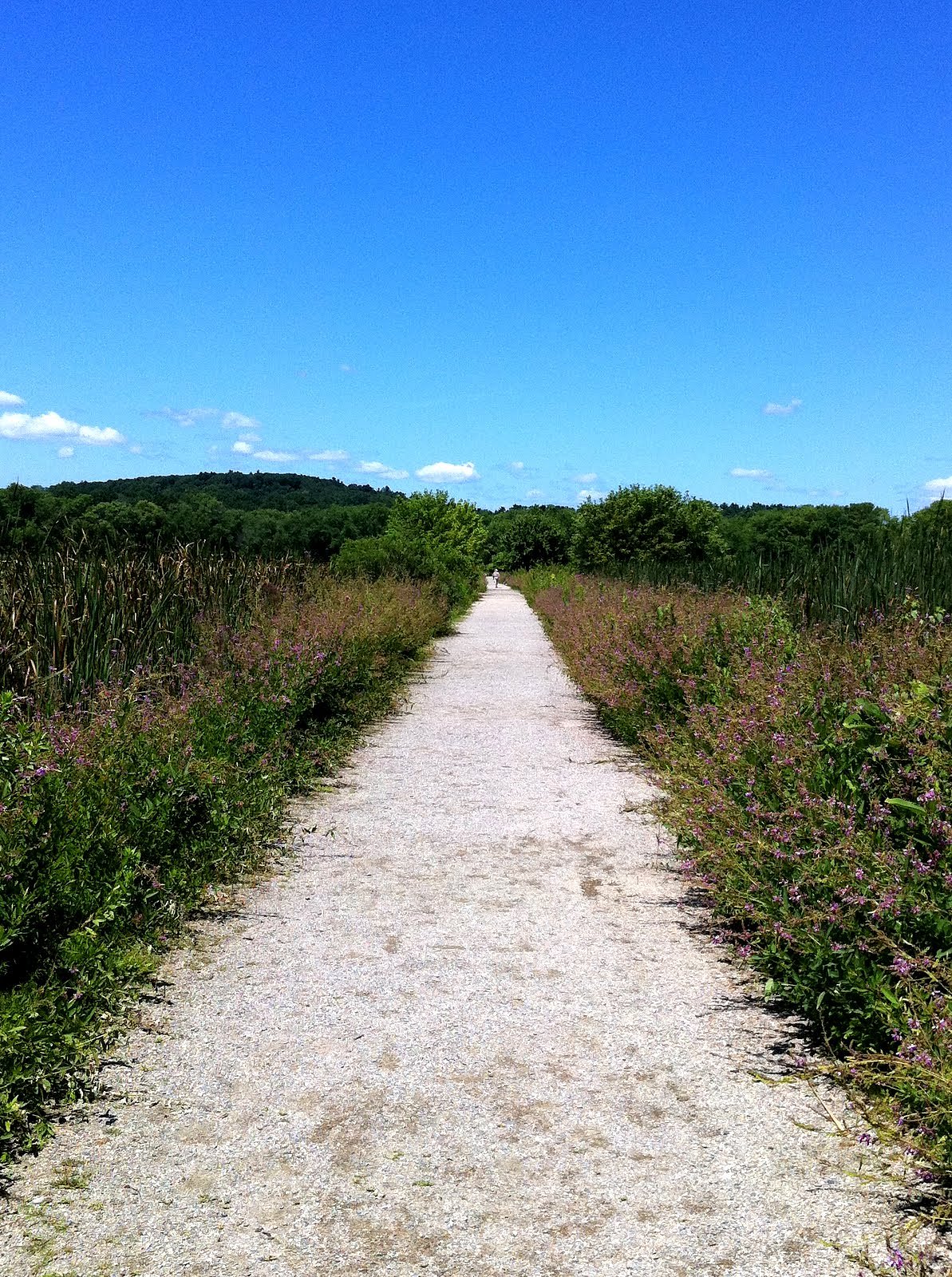
Our late arrival had its benefits, though. We found the small parking lot almost empty. And to our surprise, a gentle breeze cooled the long sunny Dike Trail that wends its way through the wetlands. A perfect time to visit.


The birds, however, had other ideas. I saw a lone red-winged blackbird, got a brief glimpse of a brown thrasher, and spied a great blue heron fishing far off amid a sea of yellow lotus plants. Other than that, I have no exciting bird sightings to report.


Nor did I come across much in the way of wildlife, other than a single small turtle making its way slowly across the trail. When it saw us, it withdrew its legs, apparently attempting to resemble a rock.


Purple loosestrife ran riot along the edges of the wetlands. Though an invasive species, its vivid flowers brighten up the landscape. In fact, the plant was brought to North America from Europe during the 1800's as a garden perennial.


Once we had traversed the wetlands, we took a brief detour down to the banks of the Concord River, which flowed so smoothly and peacefully that I wished I had a kayak handy.


Then we headed back to the trail, which took us on a loop around the outer edge of the wetlands. The breeze slacked off there, but just as the heat began to bother me, the trail entered a wooded area. We were still circuiting the wetlands, but now from within the surrounding foliage.


Once in the shade, we picked up our hiking pace and soon reached our starting point, having gone full circle. The total hike was about 2.7 miles. We agreed that, even during the heat of the day, we couldn't have found a lovelier place to walk.


I've tried to capture some of the beauty of Great Meadows in these photographs (taken with my trusty iPhone camera), but nothing can compare to the original, composed by nature.  Click on the photos to enlarge them.

Friday, June 24, 2011

The Trip

We are all on a journey. Some of us fly off to Argentina or France or China. Others take a road trip from London to England's north country, where they sample the haute cuisine of the region and do spot-on impressions of their favorite actors. Still others travel to the far reaches of Cambridge, Massachusetts, where they sample sustainable ingredients at a local eatery and see a film about two guys on a road trip to England's north country.

This latter was the journey E. and I chose to take earlier this week, and it proved to be an arduous voyage indeed. The day dawned cloudy and threatening. Our plans for a walk by the water under sun-drenched Boston skies were soon rained out, so I proposed instead a trip to see The Trip at the Kendall Square Cinema, preceded by lunch at EVOO, a Cambridge restaurant I'd been wanting to try. So far, so good.

Our drive to Cambridge was uneventful but parking, always a challenge in Cambridge, lived up to its reputation. We saw a spot on a side street near the restaurant and opposite a parking garage. The spot was on some gravel just outside a fenced-in construction site. I looked for signs prohibiting parking and saw none, until E. and I had exited the car and were about to turn the corner. There it was, in no uncertain terms—Your car will be towed if you park here. Into the jam-packed parking garage we went.

We finally found a spot on level A2, then wandered about the garage like wayfarers lost on the moors. Eventually, we located a staircase, escaped the garage, and made our way to EVOO, which, by the way, stands for extra virgin olive oil. Now that I'm eating vegetarian, ordering was easy, since there was only one vegetarian item on the menu, a concoction containing polenta, basil, zucchini, and other mysterious vegetables. Again, so far, so good.

By the time the polenta arrived, however, forty-five minutes had elapsed. Fearing we'd be late for the film, we gulped down our food. The waitress offered to validate our parking, after which we were good to go, or I should say going for good, since the meal hadn't left us with a desire to return.

It was pouring as we exited the restaurant, so we decided not to walk the half mile to the theater. Instead, we dashed to the parking garage to pay and then retrieve our car. Imagine our surprise when the cashier informed us that the validation was invalid. "Only after 4 p.m," he said. So, we forked over $10 and wandered lonely as clouds o'er floors of sedans and SUVs in search of our vehicle. Level A2 appeared to have moved since we parked there, but eventually we located the car and exited the facility. 

We headed up Binney Street to another garage, this one adjacent to the cinema. After parking, we found our way quickly out of the garage, but managed to walk in the opposite direction from the cinema as the rain fell in sheets. Once we realized our mistake, we hightailed it to the box office and, facing the disconcerting truth that at 62 years old we qualify for a senior discount, we bought our tickets and found seats in the near-empty theater.

You may be thinking by now that I've been describing a pretty nice day, albeit a damp one. After all, I was lucky to have the leisure time to do something fun with E. So what if it was a little rainy? So what if the restaurant was a bit of a disappointment? So what if we had to squander a few extra dollars on parking? We had reached our destination and could settle in to watch a good film.

But there you would be wrong, on two counts. We were not able to settle in, at least not comfortably. And the film, while occasionally amusing, did not meet our expectations for a laugh-out-loud movie experience.

Regarding the problem of settling in, the theater was cold. Very cold. I had worn a sweater, but it felt thin and threadbare in that drafty environment. I could relate to the film's two main characters, whose road trip took them through the frozen north country during the dead of winter. They, however, had parkas. I had only my sweater. I attempted to snuggle with E., but this proved impossible, given the metal arm-rest and cup-holder that came between us.

As far as the film itself, while not terrible, it did feature too many meals involving scallops and exotic meats (a running joke, but not so hilarious to a vegetarian). At times, I found the movie rather endearing and almost laugh-out-loud funny, but not endearing or funny enough to justify the expensive parking garages, the disappointing lunch, the $8/person tickets (and that's with the senior discount!).

By the end of The Trip, I actually felt my age, hunched over as I was against the cold. What warmed me was the thought of the Netflix DVD of an MI-5 episode that awaited me at home, to be watched in the cozy comfort of my own family room. And it occurred to me that The Trip might have been a much more enjoyable trip had I seen that, too, on DVD.

I won't go into boring detail about our drive home. It can be summed up in a few words—rain, rush-hour traffic, Memorial Drive. As we sat in gridlock, E. and I reflected on our day's journey and what we had learned—always bring a heavy jacket to air-conditioned places and avoid seeing movies in movie theaters if at all possible. Not the most profound lessons, but in the journey that is life, ones worth remembering.

Friday, June 3, 2011

Spider Philia

I think I might be taking this animal thing too far. In this blog and in my life, I've been increasingly smitten with animals of every variety, from dogs and ducks to fish and chickens. But lately, I've even been feeling kindly toward spiders.

Like many people, I've always had a mild spider phobia and I've definitely had a healthy fear of dangerous species. When I was in my twenties and living in California, for example, I didn't hesitate to kill a black widow that had the temerity to crawl up my kitchen wall. Actually, I called E., who killed the spider with a folded New Yorker Magazine, allowing the creature a literary death more eloquent than my current description of its demise.

One morning this past winter, while I was still in Florida, a small brown spider crawled out of the pocket of my jeans just as I was about to put them on. Fearing that it might be a dreaded brown recluse, I killed the spider immediately, this time doing the dirty deed myself. Over the years, I've realized that E. doesn't like killing arachnids any more than I do, so I really couldn't foist the job on him.

Once I'd disposed of the spider, I spent a considerable amount of time researching brown recluses on the Internet and trying to convince myself that the spider I'd killed was a southern house spider, a non-threatening variety that looks a lot like a recluse. It would have helped my identification had I trapped the spider in a glass so I could get a careful look. But having squished it beyond all recognition, I never could be sure exactly what I'd killed. Consequently, until we left Florida, I shook out every item of clothing before putting it on, lest another brown spider be lurking in some crevice. I'm not a world-class worrier for nothing.

Now that I'm back in Massachusetts, though, I've stopped worrying too much about that particular species. So far, I've mostly seen an occasional pale house spider idling on a wall in my house or garage. For a long while, I've had a policy of leaving such harmless spiders alone, unless they made the mistake of hanging out in my bedroom. Then, my normal response was to kill them. The thought of a spider crawling into my bed while I slept was simply too much to handle.

Now I'm not sure I would even draw the line at my bedroom. During the past few weeks my spider phobia seems to have shifted toward spider philia—I gaze at the little tan spider on my bathroom wall with something approaching brotherly love, or at least cross-species friendship. The thought of killing the innocent creature makes me almost sad. So far, I haven't had to confront a spider in my bedroom or one crawling out of my shoe, for that matter.  But my inclination is increasingly to live and let live, at least if I know the spider isn't likely to administer a fatal bite in return.

Lest you think I've become a total vegetarian wimp, rest assured that I wouldn't hesitate to destroy any cockroach that came my way. The same goes for earwigs, millipedes, and silverfish. Speaking of silverfish, spiders prey on them. So, long live spiders!

Sunday, May 22, 2011

Down on the Farm

The cottontails, robins, squirrels, and other backyard creatures I've spied since returning to Newton have added pleasure to my days. It's been especially nice to open the windows and hear birdsong while I work. But I still miss my toy poodle, Cosmo, who died almost ten months ago, and I yearn for closer contact with animals. I'm not ready to commit to another pet, but I knew where I could find a barnyard full of animals—Drumlin Farm in Lincoln, Massachusetts.

Drumlin Farm is a wildlife sanctuary as well as a real working farm run by the Massachusetts Audobon Society. I remembered it well from the days when E. and I brought our children there to marvel at the animals, but it had been years since we'd visited. I wondered whether he and I would be the only adults unaccompanied by youngsters. I needn't have worried. There were lots of other adults enjoying the spring day, walking on the nature trails, and delighting in the antics of the farm critters. Lots of kids, too, both of the goat and human variety, which only added to the fun.

Thanks to Cosmo, I've become much more attuned to animals and the value of their lives. I recently read Eating Animals, by Jonathan Safran Foer. His description of modern factory farming of animals filled me with horror and shame, so much so that I'm now eating mostly vegetarian. Occasionally, I make an exception for wild fish, pastured chicken, or grass-fed beef. I'm not totally opposed to eating meat, but I believe that animals should have a life worth living before their ultimate death. Happily, at Drumlin Farm they live that kind of life. (Note: All of the photos below can be enlarged by clicking on them.)

Before we reached the actual farm complex, we visited "Bird Hill," home to injured birds given sanctuary by Drumlin Farm. Among them were a barred owl, a broad-winged hawk, a turkey vulture, and this pheasant, who seemed content enough, though I felt sad to see it confined to a cage, albeit a roomy outdoor one.


As we were leaving Bird Hill, we encountered a volunteer holding an American kestrel, which is a small falcon. This bird had not been injured but had been rescued as a baby and had imprinted to humans so could not be released into the wild. The handler assured me that it has enough space in its large cage across the road to experience some of the thrill of flight, though nothing like its wild cousins enjoy.


On to the farm! I found the chickens enchanting—curious, lively, playful. At Drumlin Farm, they have a pleasant outdoor enclosure which abuts a well-maintained indoor space. They can go back and forth at will. This healthy rooster did his rooster thing, strutting his stuff for everyone to see.


Our next stop was the pig area. The pig family was knee-deep in mud, the mother rooting away. Every time the piglets tried to nose in and join her, she shoved them away with her snout, which elicited high-pitched squeals. To my untrained eye, at least, it looked like pig heaven.


The sheep were nearby, doing what sheep do, eating grass and baaing. The one pictured is a natural-colored member of the Romney breed (I'll resist any political jokes). I like its black face, how neatly delineated it appears from the sheep's thick fleece.


The goats and sheep live in close proximity and share a big shed. In fact, you can see a sheep among the goats at the back of the group photographed below. I love how the kid clumsily climbs on the mature goat's back. And she doesn't seem to mind. She may or may not be its mother—a few moments earlier, the same kid was standing on the sheep's back!


There was lots more to see—cows, the resident pony, a vernal pool, an indoor-outdoor area housing rescued red foxes, opossums, and New England cottontails, and even an exhibit about bats, featuring hand-made bat houses. All in all, a great day down on the farm.

I can't resist posting the following YouTube video, taken by another visitor to Drumlin Farm, which captures the sheep noisily demanding their feeding. (To see the video in its correct aspect ratio, link to http://youtu.be/RSPZSkLWsH4.) Who knew sheep could make such a racket? If you can't take the noise, skip to about the three-minute mark and you can watch the sheep react when their food finally arrives.


Sunday, May 15, 2011

Last Sightings Before My Northern Migration

Earlier this week, I departed from Miami and returned to Newton, land of New England cottontails, wild turkeys, and red-tailed hawks. Since my arrival, I've spotted a Baltimore oriole, many mourning doves, several robins, and a couple of cardinals, in addition to numerous bunnies and a lone hawk. The turkeys have yet to make an appearance, but their droppings on my driveway make it clear they still live in the neighborhood.

Spring rains have turned my lawn a lush green and my perennials will eventually attract gold scores of goldfinches and butterflies. There's much to enjoy here in the way of wildlife.

Still, I found it hard to part from my aerie overlooking Biscayne Bay. Every walk along the Bay holds the tantalizing possibility of encountering something unexpected. During my last few days in Miami, I spent extra time scanning the clear waters in the hope of seeing a spotted eagle ray or perhaps an unusual crab or some exotic tropical fish. My efforts were rewarded when I spied a small, round stingray I'd never seen before. And for once, I had my iPhone camera handy.


It took some detective work on the Internet before I made a positive identification—a yellow stingray. These rays have periscope eyes, giving them a 360-degree panoramic view of their surroundings. So, I'm pretty sure that while I was watching it, the yellow stingray was watching me back.

A few moments later, I noticed a gorgeous southern stingray cruising just above the seagrass. I've seen southern stingrays before, but never such a beautiful specimen and never when I had a camera on hand. Notice the delicate blue along the edges of the ray's wings and tail.


The real surprise of my day came as I ended my walk and crossed the parking lot toward my apartment building—I found one of my two Muscovy ducks happily slurping water from a drainage grate. I hadn't seen either of them for days and had even wondered whether they'd migrated north.

The duck looked up briefly when I greeted it.


Then it ruffled its feathers and resumed drinking, as the photos below show.


I felt delighted to see my feathered friend and a great sense of closure at its return only two days before my migration north.

Now that I've settled into my Newton abode, I look forward to taking a walk to nearby Chandler Pond. I'm hoping to greet the ducks there, as well as the geese, cormorants, red-winged blackbirds, turtles, and maybe a couple of swans.

Click on the photographs to enlarge them.